Mary Medlicott, Storyteller and Author - Storyworks

Archive for the ‘Folktales’ Category

Storytelling Starters ~ Jump to it!

Saturday, June 28th, 2014

Each day in my email Inbox there arrives a posting from Wordsmith. This is an excellent web-site for anyone with a relish for words. Each week Wordsmith takes a different theme for the daily words that are chosen. This week’s were all related to creatures. One of the creatures was flea and the associated word was ‘puce’. (more…)

Storytelling Starters ~ Tomorrow’s flowers

Saturday, April 26th, 2014

“All tommorrow’s flowers are in the seeds of today.” Spelling mistake included, this was the thought on a hand-written sign in a florist’s shop I passed on Friday.

The thought kept jangling in my mind. Where had I come across a similar idea? Surely it was only a few days ago? Surely I could remember? Then, this morning just before sitting down to write this blog posting, I did.

“Life is funny sometimes – how small acorns of an idea grow into something so much more and take on a life of their own.”

The comment was in an email earlier this week from a teacher I’d worked with a few years ago. At that time, she took up storytelling with her class in a big way. It’s great to hear that evidently she has stuck with it. Obviously, it’s grown into something important for her.

Both comments made me remember a story.

The story: Tomorrow’s flowers

bluebellsOnce there were two water pots. One was whole. One was slightly cracked. Each day, their owner, a farmer, would sling them over his donkey, one each side, to go and fetch water from the well.

On the way to the well every morning, the uncracked pot would mercilessly boast to the other. ‘I’ve got no cracks but you’re rubbish. I don’t know why our farmer doesn’t chuck you away.’

And so on…and on … Every day it was the same (and I think there are some people who are just as destructive in the way they put others down.)

In the end, the pot with the crack burst out to the farmer: ‘I can’t stand it any longer. I’m no use at all. You should throw me away. Who would want a pot that is cracked?’ (more…)

Storytelling Starters ~ Getting Participation/ 4

Saturday, February 15th, 2014

The storyteller, Beulah Candappa, said it brilliantly: ‘Storytelling is the art of time and silence.’ How right she was. Time is especially important with young children. Making time, taking time, valuing the time that’s taken – all helps with encouraging participation. And in that connection my tip this week is about getting participation through the way you use words.

Parents, teachers, Nursery Nurses and others have often commented to me that when I’m telling a story, it may take twenty minutes, but when they retell it, it takes just three. So what’s the difference? I’m certainly not claiming that all stories should take twenty minutes. What I do say is that, with young children, the story should feel long enough. Long enough for the children to relax and get into it. Long enough for them to feel they’ve inhabited it and been on a journey with it. In this respect, it’s my belief that an enormous difference is made by the words you use and how you use them.

The Naughty Little Mouse:

Yesterday, for instance, I was telling the story of The Naughty Little Mouse. You can find a full version in my book, Stories for Young Children and how to tell them! where it’s also on the accompanying CD). I was originally told this little folktale by a woman from India. In my subsequent retellings, I found I was adapting it more and more for children in the UK.

In The Naughty Little Mouse, the little mouse first manages to inveigle a shop-keeper into giving her a piece of cloth. In a second shop, she gets the cloth made into a hat. In a third, she gets the hat decorated with braid and sparkly sequins. Finally, finding herself in Buckingham Palace, she succeeds in getting to sit on the Queen’s throne for one whole day before, at the end of the story, she goes back home. By the time she arrives, she’s exhausted.

Cloth? Throne? Exhausted? (more…)

Storytelling Starters ~ In the Deep of the Night

Saturday, December 14th, 2013

Why is it that the stars in the sky especially draw our attention in winter? In the deep darkness of this part of the year, they seem to shine all the brighter.

As well as playing a prominent part in the story of the birth of Jesus, stars are present in so many of our Christmas traditions – at the top of the Christmas tree, in street decorations, on Christmas cards. For me, they are a vital theme in stories for this time of the year.

Stars are about the magic of looking up into the sky and feeling an immensity that’s beyond our imagining. Yet our imaginations lengthen and widen in the very act of looking.

Loawnu Mends the Sky: a Chinese story

One star story I love telling to children is about how the stars first got into the sky. I came to know it in a beautifully written version which was sent to me by Vivienne Corringham for possible inclusion in my collection of stories, Time For Telling.

Time For Telling came out in 1991. It proved very popular and  ‘Loawnu Mends The Sky’  deserved its place there.  It’s very well worth looking up. If you can’t find Time For Telling, (it’s out of print but is still held by many libraries), you might be able to track down the two paperback volumes into which it was later divided. Loawnu Mends The Sky’ is included in the volume entitled, The Big-Wide-Mouthed Toad-Frog. What follows is my summary of it – but it’s really not difficult to imagine how to fill it out for a full telling. (more…)

Storytelling Starters ~ The Path of Light

Saturday, December 7th, 2013

Christmas is coming, the goose is getting fat and it’s time to tell some good winter stories, the sort that give us the kinds of symbols we need at this time of the year. Light in the darkness. Kindness to others. The beauty of giving presents. Getting together and making good cheer.

So between now and Christmas, I’ll be doing what I usually do – reminding myself of some of the stories I’ve found it good to tell in the lead up to Christmas.

My story today is really about the power and comfort of light. It has no specific link to Christmas. Yet it feels as if it fits. For as my South African god-daughter noticed when she came here the first time – it was what made her feel the British winter was special – lights in the darkness are magical things. Candle-light, firelight, the sparkle and dazzle of Christmas lights in the trees – even the Oxford Street lights this year, lights within giant white snowballs, are enough to bring a sense of wonder and cheer.

So here it is, a Chinese story about a young man who gets lost in the darkness on his way home after finishing work late one very cold winter night. The young man is called Kuan Lo and my name for the story  is The Path of Light.

The Path of Light

It was very cold and very dark and very late when Kuan Lo started walking home. Worse still, when Kuan Lo was crossing the moor that he had to cross in order to get home, he suddenly realised he didn’t have a clue where he was. Somehow or other, he’d lost his way. Then, just as he was wondering what he could possibly do, he saw the flames of a fire ahead and from the same direction came the sound of laughing voices.

When Kuan Lo reached the fire, he saw a most surprising sight. Sitting very comfortably on the ground round the fire were a whole lot of big men. They looked just like wrestlers usually looked and Kuan Lo felt a little bit worried. What if they started to fight him?

Instead when the men saw him, they called out in the friendliest way. ‘Come and have a drink with us!’ So Kuan Lo sat down and at once they were all chatting and laughing. The men were extremely sympathetic when Kuan Lo said he was lost and then after a while, they said they’d like to show him a trick that they had. Kuan Lo wondered what they were going to do.

Well, each one of the wrestlers stood up – they were very big men with big, fat stomachs – and in an instant they were climbing on each other’s shoulders, one after the other, until they’d made a high tower of people. It seemed to reach up to the stars. Kuan Lo looked up at it in amazement. Then, oh dear, it started to wobble and suddenly the tower of people was falling. And it fell, but very slowly and gently, until it was lying flat on the ground.

But when Kuan Lo looked where the tower had fallen, he saw no people, just a long path of white light. At once, the path of white light began moving slowly, gradually, over the moor. Kuan Lo was amazed and started to follow. And do you know what? That path of white light took him all the way home. It didn’t seem to take long to get there and when Kuan Lo saw his own little house, he felt very glad and grateful. ‘Those wrestlers made a path of light and it’s brought me safely home,’ he said to himself as he opened his front door and stepped inside. ‘I’ll never forget them’.  And he never did. (more…)

Storytelling Starters ~ Time to tell

Saturday, October 26th, 2013

Do I dare call myself a storyteller? Hallowe’en is a popular time for storytelling. Yet I absolutely hate Hallowe’en – not because of the spectres, witches, zombies and demons but because of the commercialisation. Fancy-dress clothes get hired, kids run round knocking on doors, then look at you blankly when you appear, not sure what to say or quite why they’re there.

Baba Yaga

I don’t like Hallowe’en but I like Baba Yaga, the ugly old hag of Russian fairytale. She seems entirely the sort of ambivalent character we could do well to remember at this time of the year. A creature who inhabits the shadows, she lives in the depths of the forest in a hut with chicken legs that spins endlessly round. To get in to the hut, indeed to survive Baba Yaga at all, you have to know the correct thing to say. According to Afanas’ev, the Russian story-collector, she uses her very long nose to poke the fire and her sharpened iron teeth to devour young, tender victims.

But it’s often possible to outwit Baba Yaga. In fact, sometimes you feel she’s got something extremely insightful about her – for if you have courage and a good, kind heart, she ultimately respects it and will spare you. And when she spares you, you will afterwards be all the stronger for it.

HAG

Last week, I encountered Baba Yaga when I went with one of my god-daughters to see a play called HAG at the Soho Theatre in London. Produced by The Wrong Crowd company, the play generally followed the pattern of Vasilisa the Beautiful, one of the most well-known of Baba Yaga stories. It made strong use of puppets but was by no means aimed at young children. From its hilariously satirical approach to the stepmother character and her two mocking daughters (these were shown as a bodiless, twin-headed puppet), I could sense how it would appeal to the teenage audiences for whom it’s apparently at least partly intended. The play’s main character is a sweet-natured girl whose mother has died. With so heartless, vain and cruel a stepmother, she has in consequence to face some of the worst demons this world can throw up.

Coming out of HAG, it was particularly nice to encounter a large group of young women who, it turned out, had been brought to see the play by their English teacher. They had obviously got a lot from it.

So let me recommend Baba Yaga stories for audiences young and old. Plenty can be found on the Internet and, for young children, there are a number in picture-book form. In these, quite suitably for the age-group, Baba Yaga is usually presented simply as a witch who has to be fled. HAG reminded me that Baba Yaga’s significance can be more complex and, as such, her appeal far wider.

And meantime remember your clocks …

Yes, do remember to turn your clocks back on Saturday night or Sunday morning.

I well remember the occasion when Paul and I were in Italy on holiday and, over several days towards the end of our holiday, were surprised to notice that our hotel dining room was virtually empty each time we turned up there for dinner. Not until the morning that we left did we understand why.

Because of the earliness of our departure, we’d organised with the hotel-owner the night before that he would be up early in the morning to sort out our bill. We got up. He wasn’t there. Indeed, he had to be sent for and when we finally saw him coming up the road, he was still doing up his trousers and repeatedly calling out ‘Mama Mia’ in a long-suffering voice as if he couldn’t quite believe what these mad British people were up to. Shortly afterwards, we realised why. Days before, the clocks had gone back. We’d been completely oblivious.

Got any similar stories? The theme’s a good one for story-sharing. (more…)

Storytelling Starters ~ Tellable tales

Saturday, September 14th, 2013

It’s great to come across a new collection of extremely tellable tales. Girls, Goddesses and Giants by Lari Don (A & C Black) has just this week come into my hands as one of a lovely pile of books I’ve been sent to review for School Librarian magazine. Chris Brown, the magazine’s long-term Books Editor, is just about to retire from that position. He’s done a marvellous job over all of the years. I shall miss him. He always seems to know what books I will value receiving.

Girls, Goddesses & Giants addresses a continuingly important need in stories, namely for strong girl heroines. When I was growing up, I always identified with the young men who were the usual fare in the hero department. Heroines were in shorter supply. Whenever a brave prince was rescuing a kidnapped princess doomed to be sacrificed to a voracious dragon, I became the sword-wielding prince as well as the princess.

Lari Don is not only an author. She’s a practising storyteller too. She has felt the same strong need. And as she says in notes at the back of her book (these include helpful hints on adapting stories to suit your own style), she has felt compelled to satisfy it even while actually being in the middle of telling to an audience of children. The 12 stories in her collection come from all over the world. One of my favourites is a Cameroonian tale, Mbango and the Whirlpool. It brought back to my mind Philip Pullman’s point, made in the interview I quoted a week or two back, that a main reason why children love folktales and fairytales is their belief in justice. They want to see fair play being done. (more…)

Storytelling Starters ~ Fire and wind

Saturday, June 22nd, 2013

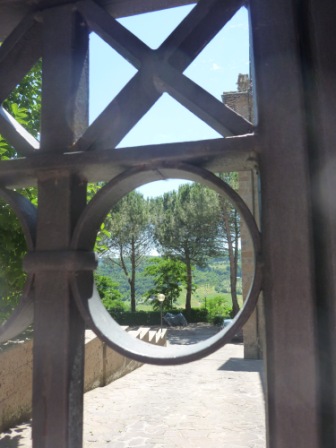
My Blog-break was in Italy. And very lovely it was too. Evenings, we lit candles in the Umbrian villa we’d rented with our group of friends. The first couple of days, there were dramatic rain storms and a lot of wind. The rest of the time, the weather was hot and getting hotter. Lovely. And there were stunning views, a garden full of flowers including my favourite Love In The Mist, and when we went visiting hill-top towns, there were intriguing sights to photograph. Plus gorgeous food.

Every now and then while away, especially in the evenings when we lit those candles, I thought about the little riddle I’d included in my last Blog.

The riddle:

How can you get fire wrapped in paper?

The answer:

The answer is obvious when you know it and most obviously satisfying when you see it made real, brought out in the form of an object. For the answer is a paper lantern. The candle inside is the fire. The paper around it makes the lantern.

The story:

So clever, so simple, the riddle plays a key part in a Chinese folk-tale I was told just before I went off to Italy. The teller was Nada, one of the excellent people on my Kensington Palace parents’ workshop. She’d found the tale in a picture-book version and had recognised it at once as a good story to tell. Besides, she’d taken the trouble not only to remember the story but to equip herself with a good-looking bag for the props that she’d prepared.

Out of this bag, at the appropriate moment, came a lovely Chinese lantern. And shortly after – for as you’ll see, a second riddle is also contained in the story – she brought out her second prop. This was equally simple, equally magical.

Read on and you’ll see what it was. (more…)

Storytelling Starters ~ To inspire

Saturday, May 18th, 2013

The essential point of any storytelling workshop or course is to inspire and impart – not to disempower. Participants can be enthused in different ways and with diverse outcomes. They may become tellers of stories in their family lives. They may start telling, making and hearing stories with people they work with. They may even conceive the ambition to develop themselves as professional or semi-professional storytellers.

Palpable excitement

On Wednesday and Thursday this week, I felt particularly conscious of this multi-faceted effect. On Wednesday, I was at Warwick University doing one of my annual sessions with students on Hilary Minns’ storytelling module for people working with children. Thursday was the final session of my Kensington Palace course for parents. Both times, I felt the palpable excitement of people who have already started to experience the effects of their storytelling on children. And not only children. One Kensington Palace mother read us a story she’d written during the week. Beautifully written it was too. During the course, she told us, she felt she’d discovered a new facility for writing. She reported how affected her husband had been by this.

New skills, new confidence, new powers of invention: the KensingtonPalace crowd will, I feel sure, go on to great things. Already they are well into planning storytelling clubs for the children in the schools their children attend. I have offered my help in getting these going.

As for the Warwick University students, they’ll soon be planning and writing their end-of-course dissertations. In doing this, they will be using and recording their own new awareness of the effects of stories on children.

Leading workshops – a particular skill

But it’s an important point to make: leading workshops in such a way as to produce these effects is a particular skill of its own. I know I’m good at it (I should be by now!) and of course I know it’s not the only way of working as a storyteller. (I love the other ways, too.) But it does require a particular set of qualities – knowing how to put participants at their ease; activities that can involve all in the group, including the shyest; a storytelling style that does not show itself off but encourages people to feel they can do it too; a way of working that recognises and develops people’s individual interests, skills and styles. And last but not least, a love of employing and sharing the ‘secrets’ of the storytelling art.

The need today

It’s a tall order. And it represents one of my current concerns about what’s happening with storytelling in education today. Right now, we badly need more storytellers who want to foster this way of working so there can be more parents, more teachers and more childcare workers spreading the joys and wisdoms of storytelling. Is enough happening to fund this kind of development? Are enough people aware of the need? What happens if and when this kind of workshop-running dies out? (more…)

Storytelling Starters ~ Feast

Saturday, May 11th, 2013

Storytelling Cookbook was the title I gave the first little book I put together with stories for children and hints on telling them. No doubt the name came to mind because I can’t help thinking of cooking and eating in connection with storytelling. Listening to stories or people talking about them just feels like participating in a feast. A traditional Scandinavian tale-ender gives the idea another twist:

 ‘And all I know is, that if they are not yet done feasting, then they are probably at it still.’

In other words, when a story ends well, it’s not hard to imagine the characters in it sitting long into the night , chewing things over in more ways than one. When I’m finishing a story with children, I often bring in that idea of eating afterwards – it’s a little bit of a tease.

A tale from India

For instance, in that marvellous Indian tale, Bhambhutia,  (you can find it in The Singing Sack by Helen East), an old lady is threatened with being devoured on her way through the forest to visit her daughter.

The story describes how she succeeds in getting back home inside a life-size clay pot she constructs. But the old lady is clever enough to stay in the pot till the animals who still want to eat her have gone to sleep and are snoring around her. It’s when she hears their snores that the old lady knows it’s safe to climb out and quickly run into her house. But that’s not quite the end of the story. Next morning, she gives the pot its reward for bringing her safely home. Either it can go round the world or it can stay with her.

It’s a good point for a bit of discussion. In my experience, lots of children say they’d choose to go round the world – and in multi-ethnic Britain, many say they’d visit the countries where their families originated. Equally, lots of children decide that, if they were the pot, they’d stay at home with the old lady. We talk about it. Then I end the discussion like this: ‘Well, in the story, it says the pot decided to stay with the old lady. And I know that’s what it did because the last time I went to have tea with her, it was still there.’

The proof of the pudding – Kensington Palace revisited

The proof of the storytelling pudding lies in the eating. Thursday was the 6th session of my Kensington Palace storytelling course for parents. It was intended as an opportunity to reflect on what has happened up till now and what might happen after this. The parents’ reports provided a feast. (more…)