Archive for the ‘Folktales’ Category
Saturday, April 30th, 2016
 The Rajah with Enormous Ears is, deservedly, an extremely well-known story. One thing that intrigues me about it is the different versions that exist in other cultures. Did it travel to those places from India? Or did other peoples in other lands come up with the same idea?
In ancient Greece:
Perhaps the oldest version of the Enormous Ears theme occurs as part of the story of King Midas from ancient Greece. Here, Midas is punished with a pair of ass’s ears when he disagrees with the verdict in a famous musical contest. For a long time, he manages to conceal these big ears under a Phrygian cap. But his barber who is the only person aware of the secret cannot bear keeping it to himself. So the barber digs a hole in the river bank and whispers the secret into the hole. ‘King Midas has ass’s ears.’ Then the barber fills up the hole not knowing that, soon, a reed will sprout from the hole and whisper the king’s secret to all who pass by. When Midas learns that his disgrace has become public, he condemns the barber to death, drinks bull’s blood and dies a miserable death.
Tags: ear, harp, instruments, Labra the Mariner, March ap Meirchion, Midas, Rajah, reed, secret, The Rajah With Big Ears, tree
Posted in Body Stories, Folktales, Getting participation, Primary, Props and Resources | 3 Comments »
Saturday, April 16th, 2016
Cracking eggs into the mix for a fruit-cake yesterday morning, my thoughts turned to the current situation of a young friend. Suddenly I found myself thinking: ‘Don’t put all your eggs in one basket.’ So appropriate did the old saying seem to the circumstances I was considering that, as I added the flour to the mix, I began to remind myself of the story behind the adage.
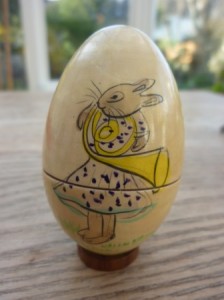 Don’t put all your eggs in one basket:
On a lovely Spring day, a lovely young country girl is tripping down the lane towards her local town, a basket full of eggs on her arm. And as she goes she is thinking. When she’s sold the eggs at the market – and she’s bound to sell them for they’re lovely fresh eggs – she’ll have enough money to spend, just enough, to buy a pretty new ribbon for her hair.
And when that pretty new ribbon is in her hair, she dreams, she’s sure it will please the boy that she fancies. The boy likes her already, she’s quite sure of that, but when her hair is bedecked with that pretty new ribbon, she’s sure he’ll like her even more. In fact, he’s bound to ask her out for a walk and, when he does, he’ll surely want to see her again and before long, she’s certain, he’ll be asking her to marry him. She knows she’ll say yes and she also knows that when they’re married, they’ll make a cosy home and have lots of children.
But it’s just here in her thoughts that this young girl trips. Oh no! It’s that tree-root sticking up out of the path that does it. Her basket goes flying, the eggs go flying and after she’s picked herself up, she is horrified to see that every one of the eggs is broken. So that’s it: no market, no sales, no ribbon, no lover, no marriage, no children.
Posted in All ages, Folktales, Personal experience, Props and Resources, Riddles, rhymes, sayings | 3 Comments »
Saturday, April 2nd, 2016
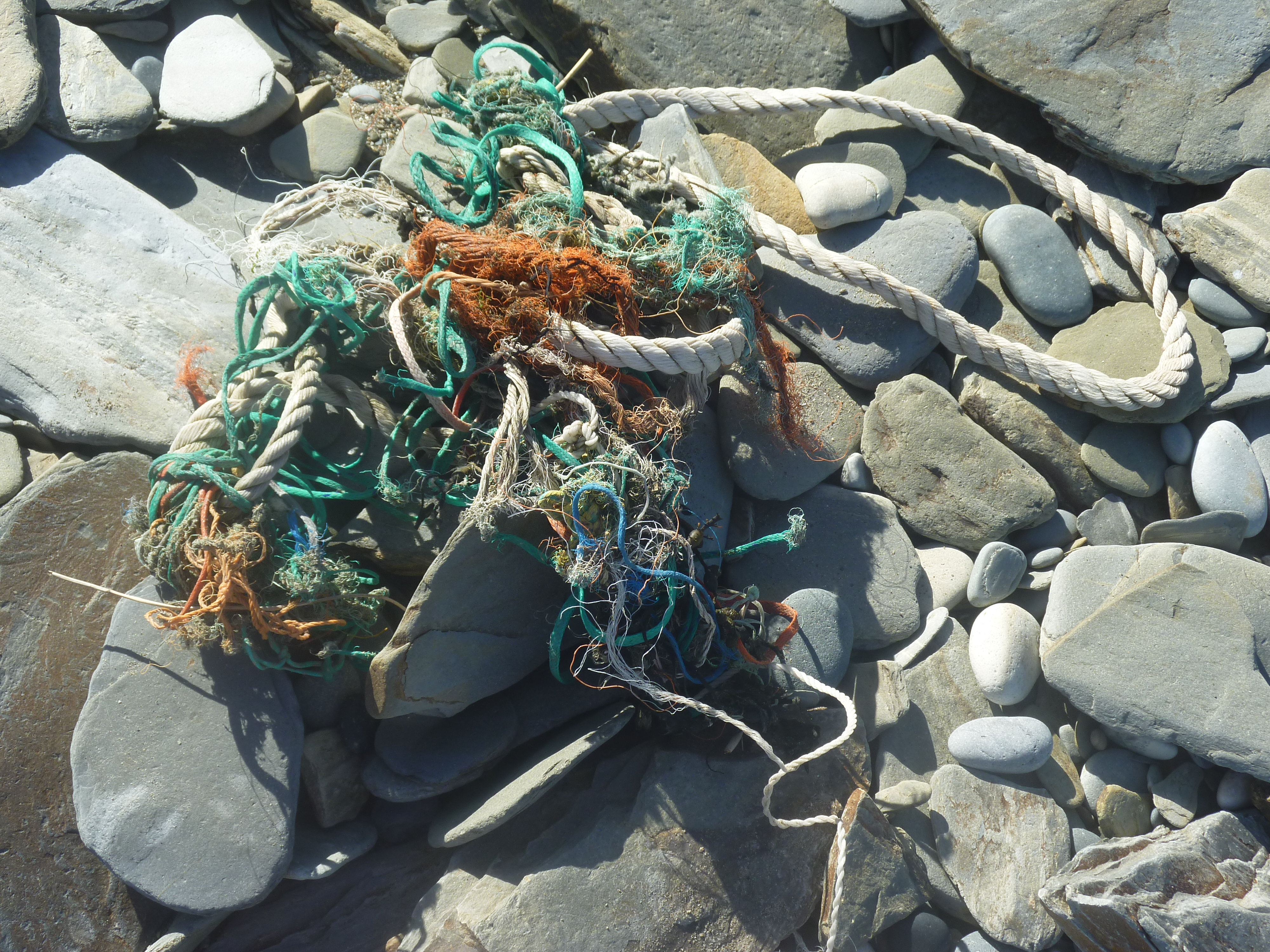
 Beach-cleaning is one of two topics that have been in my mind this week. The other one – and they make an unlikely combination – is what makes a story stick in your mind and eager for you to tell it.
The beach-cleaning came up because a recent episode of Springwatch on BBC 1 showed clips from TV coverage of the horrendous oil-spill off the Pembrokeshire coast that, some years ago, caused mayhem to sea-birds and coastal ecology. The area has long since recovered from that. But, as Springwatch pointed out, continual damage is being done by the plastics that get onto beaches and into seas. The message of the programme was simple: if you see plastic, pick it up, dispose of it properly.
Well, we’ve been in Pembrokeshire over Easter and this week, we ended a long walk along Newgale beach with quite a horde of stuff – one huge piece of green plastic tarpaulin and one small bag full of bits of plastic fishing line, including a tangled clump from the skeleton of a sea-bird that had obviously died from getting caught on it.
What’s found on beaches: a Scottish folktale
Another recent reason for thinking about what you find on beaches came up because of a Scottish folktale I came across ages ago in a book called Thistle and Thyme. In the story, a young mother has lost her baby and when it turns out that the baby has been stolen by fairy folk, she is determined to get him back. But how? (more…)
Tags: beaches, cleaning up, Cultural Connections, Pembrokeshire, plastic, Thistle and Thyme
Posted in Adults, Age Range, Folktales, Personal experience, Preparing | 2 Comments »
Saturday, March 26th, 2016
The question comes up quite often and I feel privileged whenever it does. Usually it gets asked by someone in a Year 5 or 6 class who is therefore one of the older-age children in a Primary school. Almost always, a silence has fallen before it’s asked and invariably it’s asked in a quiet, thoughtful way. The question is: ‘Is that story true?’ On one unforgettable occasion, I’d just finished telling a most unbelievable Japanese story about a lazy liar who deserves a comeuppance.
A Japanese story: The Magic Nose-Fan
 One day, lolling under a bush, Kotaro is offered a magic nose-fan by a tengu who is a kind of mischievous Japanese troll-type figure usually recognisable by his very long nose. Our anti-hero accepts the nose-fan in return for the dice he’s been idly tossing about and it’s this same magic nose-fan that leads to the story’s final denouement in which Kotaro is left dangling off a far-distant planet, his little legs no doubt kicking around in the air.
What happens in between is that our anti-hero discovers that, when one side of the nose-fan is turned towards a nose, the fan will make the nose get longer. When its other side is turned nose-wards, it makes the nose get smaller again. With judicious use, it can return the nose to its normal size.
And how does our anti-hero make use of the tengu’s gift? Why, when he sees the local princess taking the air in the royal gardens, he wanders casually by and uses his fan to make her nose get long. Panic and pandemonium ensue. What is to be done? Doctors are called. Creams are deployed. Nothing works until our lazy no-good-boyo presents himself at the palace and, in a darkened room, returns the princess’ nose to its regular size. In return he gets to marry the princess as his reward and that enables him to lead an even lazier life than before.
But here comes the comeuppance. (more…)
Tags: Japanese story, Magic Nose-Fan, making fans, Pembrokeshire, question, tengu, true or not
Posted in Adults, All ages, Body Stories, Folktales, Managing problems, Props and Resources | 4 Comments »
Saturday, March 12th, 2016
Without response, where would we storytellers be? I’d probably shrivel like the dried-up brown leaf that was on my doorstep the other morning, blown there no doubt by the winds of the previous night.
 On Wednesday this week, I was at St Peter’s C of E Primary School in Ravenscourt Park. This was a new school for me except that its new head teacher used to book me at St Stephen’s School in Shepherd’s Bush where she previously worked. Some responses occurred in the course of the day which have stayed in my mind.
Identification
In my session for the Years 3 and 4 classes, I brought out my Rainbow Cloth (I often do). It brought some lovely responses, for instance that, if it transformed, it could become butterfly wings. I also told the story of how and where I’d bought it. ‘It comes from Africa,’ I began and in the small pause that followed, my eyes were drawn to two boys, both black, who were sitting together near the back. During my pause, one boy turned to the other, nodding slightly as if to say, ‘That’s like you.’ And at once, the other boy smiled with a look of such affirmation that I don’t want to forget it.
Tags: Bangalore, dragon, Rainbow Cloth, Ravenscourt Park, St Peter's, The Magic Tapestry
Posted in Adults, Folktales, Getting participation, Personal experience, Props and Resources | 5 Comments »
Saturday, March 5th, 2016
 For any storyteller, it’s a heartening moment when you learn that a story you’ve told has succeeded in engaging a child. It’s even better when the story has become part of a kind of chain. You told it to a group of adults and it’s one of them that passed it on to the child concerned.
This week I had one such moment when I received the following message from Hilary Minns at Warwick University. Hilary has for many years been running a module on Stories and Storytelling for people pursuing Early Childhood studies. The story she refers to is one I’ve told there a number of times.
Hilary’s message:
A little story: one of my students has a group of seven children with special learning needs. Among them is a 6 year old autistic boy who, she says, dislikes stories intensely and who wriggles and squirms around at storytime. But she told him Mrs Wiggle and Mrs Waggle, complete with actions, and he was transfixed. He then asked her to make the characters into Mr Wiggle and Mr Waggle and said they had to change houses. At break time she observed this boy retelling the story to a friend!
Tags: best ever story, Hilary Minns, Mrs Wiggle and Mrs Waggle, thumb, Warwick University
Posted in Adults, Body Stories, Early years, Folktales, Follow-up activities, Performance, Personal experience | 1 Comment »
Saturday, February 27th, 2016
 This coming Monday, I’ll be at St Stephens Primary School in Shepherds Bush. They’ve asked me back over several years as part of their Arts Week and I’m looking forward to it. The children there really appreciate stories and among the ones I’m thinking of telling are some I’ve told to classes there in the past. (Children everywhere seem to love picking up on stories they’ve heard from you before).
One of the new tales I’m planning to tell is one I’ve hardly ever told before. Which age-group I’ll tell it with will depend on atmosphere and how things go at the time. First, let me give you an idea of the story. Then I’ll outline some of my thoughts on how and why I might tell it.
The characters of the story:
1. An old woman (very poor and very kind)
2. The Little Red Rooster (he belongs to the old woman) (more…)
Tags: Little Red Rooster, magic stomach, St Stephens Primary School, Sultan, treasure
Posted in Body Stories, Folktales, Getting participation, Preparing, Primary, Props and Resources, Visualisation | 4 Comments »
Saturday, February 6th, 2016
 You could play it as a game. ‘Associations’ you might call it. For instance, let’s start with the word ‘cloud’. Playing ‘Associations’, I might come up with the fact that I once knew a girl called Cloud. (‘What a beautiful name,’ I used to think.) Then again, each day when I open up my computer, on comes one of those irritating dialogue boxes: KnowHow Cloud. (‘Have you logged in to Cloud?’ it persists in asking.) Or am I remembering the Afrikaans saying I quoted here a few weeks ago: ‘And all the time we are being carried like great clouds across the sky.’
I don’t know what associations you’d put forward. Maybe you have none for Cloud. But as a storyteller, I do think it’s useful sometimes to stop and wonder. ‘ Why? What associations do I have with that story? Why do I like it so much? What is it about it that attracts me? Why am I so compelled to tell it?’
Following suit, I must ask myself why, towards the end of this week, I remembered a little story about a cloud I was once told? And why did I start thinking about it? Was it simply because I was walking down the street wondering what I’d write about today and happened to notice a distinctly shaped cloud in the sky? More than likely. Dense grey skies have been over our heads so often here in London lately (and here, thinking about what it may be like elsewhere, I must send special greetings to the growing number of readers of this blog who live far, far away, in Australia, New Zealand, India, Brazil). When the sky is one dense grey mass, there are none of those separate clouds where you might see particular colours and shapes. ‘Look, do you see the dog in the sky?’ ‘And what about that great bird on the wing!’ Or could that cloud be a boy?
The Boy Who Became A Cloud (more…)
Posted in All ages, Folktales, Personal experience, Remembering | 6 Comments »
Saturday, January 16th, 2016
 Those little stories that make a particular point can sometimes prove tricky. The last few days, the weather has been lovely in London – cold but sunny enough to bring a smile to our faces and quite a change from incessant grey skies and rain. On one of my walks, remembering the great winds that blew over Christmas, I thought about that famed competition between Sun and Wind.
Sun and Wind fight it out:
Just as children sometimes do, and sometimes even grown-ups too, Sun and Wind were having an argument about which of them is stronger. Sun proclaimed: ‘It’s definitely me.’ Wind thought differently, ‘No, it’s me.’
Sun and Wind decided to test out their claims.
‘See that young man walking down that street,’ said Sun. ‘I guarantee I can get his jacket off him quicker than you.’
‘It’s a deal,’ said Wind. ‘But I’m going to win.’
Without wasting a moment, Wind began blowing. Before he could even start roaring, the young man walking down the street pulled up the zip on his jacket. Then as Wind began roaring, he put his arms round himself, drawing his jacket even closer. (more…)
Tags: a saying for the new year, Mathri, power of wind, Sun and Wind fight it out, trees
Posted in Adults, Folktales, Nature stories, Personal experience, Primary, Symbolism | No Comments »
Saturday, November 21st, 2015
 How did it go? Most storytellers, I guess, look back at any event they’ve been involved with, formal or informal, and consider if it lived up to how they’d have liked it to be. For me, that process happened twice yesterday. The morning held a long interview on Skype with a storyteller in Bangalore in India. I’ve never been a great aficionado of Skype but this conversation was really magic. My interviewer’s list of questions was very much to the point and during it, she asked what advice I’d have for a new storyteller. My answer included what long ago became a motto I gave to myself: forgive yourself if you feel your storytelling didn’t go as well as you’d have hoped. There is always a next time and you have to learn from your mistakes.
The afternoon involved the birthday party I spoke briefly about in last week’s blog. In the event, 14 girls turned up, one or two of them rather quiet, the rest of them very excited. An initial activity involved them thinking up a magic power, a magic food and a magic creature. Then it was over to the storytelling. After a name game to help all feel included and an introductory story about a frog that happily made them all laugh, we went immediately into that story from Grimms’ Other Tales, the story of Catharinella. The children settled into it quickly, though I realised from the looks on one or two faces that even at 7 years old, the idea of an ogre that might eat you up can feel a tad alarming. Where necessary, you have to go easy. Then as we went on, I felt really glad that, in my advance preparations, I’d become aware of some unresolved features in the story as written. My thoughts about how to resolve them proved very productive and that felt nice.
The story in brief: (more…)
Tags: Bangalore, birthday party, Catharinella, forgive, Grimms' Other Tales, Skype
Posted in Adults, Folktales, Follow-up activities, Getting participation, Managing problems, Personal experience, Preparing, Primary, Props and Resources | No Comments »


 The Rajah with Enormous Ears is, deservedly, an extremely well-known story. One thing that intrigues me about it is the different versions that exist in other cultures. Did it travel to those places from India? Or did other peoples in other lands come up with the same idea?