Mary Medlicott, Storyteller and Author - Storyworks

Archive for the ‘Props and Resources’ Category

Storytelling Starters ~ In the Deep of the Night

Saturday, December 14th, 2013

Why is it that the stars in the sky especially draw our attention in winter? In the deep darkness of this part of the year, they seem to shine all the brighter.

As well as playing a prominent part in the story of the birth of Jesus, stars are present in so many of our Christmas traditions – at the top of the Christmas tree, in street decorations, on Christmas cards. For me, they are a vital theme in stories for this time of the year.

Stars are about the magic of looking up into the sky and feeling an immensity that’s beyond our imagining. Yet our imaginations lengthen and widen in the very act of looking.

Loawnu Mends the Sky: a Chinese story

One star story I love telling to children is about how the stars first got into the sky. I came to know it in a beautifully written version which was sent to me by Vivienne Corringham for possible inclusion in my collection of stories, Time For Telling.

Time For Telling came out in 1991. It proved very popular and  ‘Loawnu Mends The Sky’  deserved its place there.  It’s very well worth looking up. If you can’t find Time For Telling, (it’s out of print but is still held by many libraries), you might be able to track down the two paperback volumes into which it was later divided. Loawnu Mends The Sky’ is included in the volume entitled, The Big-Wide-Mouthed Toad-Frog. What follows is my summary of it – but it’s really not difficult to imagine how to fill it out for a full telling. (more…)

Storytelling Starters ~ Hail Mighty Sea

Saturday, November 2nd, 2013

What objects can be used to introduce and accompany storytelling? The question arrived in my Inbox this week in an email from a woman from Brazil who has newly come across storytelling and fallen in love with it. She already uses her guitar. But what else might she  employ? She’d found my website on the net and wanted to know of any books that could help.

The Magic of Objects was the theme of a series in this Blog on each Saturday of October 2011. Look them up, it’s a theme that’s close to my heart. My sea-tray … fans … colour cloths … magic music … such objects have given me enormous use in such wide-ranging circumstances. They have also observeably brought enormous pleasure to audiences of adults and children. In this week of wind and storms I have thought in particular about my sea-tray.

Hail Mighty Sea

I was first reminded of my sea-tray at the start of the week. Down on the sea-wall at Abereiddi beach, one of our Pembrokeshire favourites, words written out in pebbles declaimed the stirring message: Hail Mighty Sea.

On Abermawr beach the following day, a young boy on the pebbles was looking out to sea, arm raised in a great gesture of greeting as the incoming waves swirled over his Wellington boots. When I passed him soon after as he left the beach with his sister who’d done the same after him, they and their father looked completely delighted. The children were sopping wet but they’d had a unique experience(quite safely I might add). They’d hailed the sea in all its grandeur.

Both incidents in turn put me in mind of the Birmingham children who came on an exchange visit to the Cardiganshire coast in the art and storytelling project, On The Train, that was organised a few years ago now by artist Catrin Webster. The visiting children had whooped with delight when they caught their first sight of the sea (most of them had never seen it before) and had run pell-mell towards it and, in the case of some of them, right into it.

The sea is a fundamental experience. We should all be able to have that experience if we possibly can. If only! In the Guardian recently, George Monbiot, whose book Feral came out earlier this year, strongly urged the point that a week in the country is worth three months in the classroom. In his Guardian article he recommended that every class in every urban school should regularly be taken to spend time in the country. If only! The idea, alas, feels as unachievable in our present world as my profound wish that every class should hear (and be able to talk about) a told story once a week at the very least in every week of their school year.

Impossible? At least through stories we could give all children, older and younger, an experience of discovery and a sense of magic and awe.

The sea-tray

That’s where my sea-tray comes in. It produces the best sea-sound I’ve ever heard away from the sea itself. It can either introduce a storytelling session or a particular story. Or it can be employed in the course of a story. Use it and you take people on a real journey of the senses and the imagination.

Practical reminder:

My own sea-tray comes from a junk shop in New Zealand. It possibly originated in the South Sea Islands as a device for carrying fruit. I know similar trays are found across Asia and Africa where they are generally used for sifting rice or lentils.

To provide yourself with your own sea-tray, seek out a smooth or rough round wooden tray or perhaps a bodhran which is a type of wide Irish drum. Empty onto it a bagful of very small stones you’ve specially collected for the purpose or alternatively a bagful of beans. Swish these round in a rhythmic way, imitating the rhythms and pauses in the sound of the waves and – hey presto! – you could at once feel you were standing on the shore. Just like that delighted boy this week! (more…)

Storytelling Starters ~ Time to tell

Saturday, October 26th, 2013

Do I dare call myself a storyteller? Hallowe’en is a popular time for storytelling. Yet I absolutely hate Hallowe’en – not because of the spectres, witches, zombies and demons but because of the commercialisation. Fancy-dress clothes get hired, kids run round knocking on doors, then look at you blankly when you appear, not sure what to say or quite why they’re there.

Baba Yaga

I don’t like Hallowe’en but I like Baba Yaga, the ugly old hag of Russian fairytale. She seems entirely the sort of ambivalent character we could do well to remember at this time of the year. A creature who inhabits the shadows, she lives in the depths of the forest in a hut with chicken legs that spins endlessly round. To get in to the hut, indeed to survive Baba Yaga at all, you have to know the correct thing to say. According to Afanas’ev, the Russian story-collector, she uses her very long nose to poke the fire and her sharpened iron teeth to devour young, tender victims.

But it’s often possible to outwit Baba Yaga. In fact, sometimes you feel she’s got something extremely insightful about her – for if you have courage and a good, kind heart, she ultimately respects it and will spare you. And when she spares you, you will afterwards be all the stronger for it.

HAG

Last week, I encountered Baba Yaga when I went with one of my god-daughters to see a play called HAG at the Soho Theatre in London. Produced by The Wrong Crowd company, the play generally followed the pattern of Vasilisa the Beautiful, one of the most well-known of Baba Yaga stories. It made strong use of puppets but was by no means aimed at young children. From its hilariously satirical approach to the stepmother character and her two mocking daughters (these were shown as a bodiless, twin-headed puppet), I could sense how it would appeal to the teenage audiences for whom it’s apparently at least partly intended. The play’s main character is a sweet-natured girl whose mother has died. With so heartless, vain and cruel a stepmother, she has in consequence to face some of the worst demons this world can throw up.

Coming out of HAG, it was particularly nice to encounter a large group of young women who, it turned out, had been brought to see the play by their English teacher. They had obviously got a lot from it.

So let me recommend Baba Yaga stories for audiences young and old. Plenty can be found on the Internet and, for young children, there are a number in picture-book form. In these, quite suitably for the age-group, Baba Yaga is usually presented simply as a witch who has to be fled. HAG reminded me that Baba Yaga’s significance can be more complex and, as such, her appeal far wider.

And meantime remember your clocks …

Yes, do remember to turn your clocks back on Saturday night or Sunday morning.

I well remember the occasion when Paul and I were in Italy on holiday and, over several days towards the end of our holiday, were surprised to notice that our hotel dining room was virtually empty each time we turned up there for dinner. Not until the morning that we left did we understand why.

Because of the earliness of our departure, we’d organised with the hotel-owner the night before that he would be up early in the morning to sort out our bill. We got up. He wasn’t there. Indeed, he had to be sent for and when we finally saw him coming up the road, he was still doing up his trousers and repeatedly calling out ‘Mama Mia’ in a long-suffering voice as if he couldn’t quite believe what these mad British people were up to. Shortly afterwards, we realised why. Days before, the clocks had gone back. We’d been completely oblivious.

Got any similar stories? The theme’s a good one for story-sharing. (more…)

Storytelling Starters ~ BASE Awards

Saturday, October 12th, 2013

This evening I’m off to the BASE Awards event in Wolverton. And if you don’t know where Wolverton is, it’s right next to Milton Keynes.

Ancient Egypt and Us

Milton Keynes is a resonant place-name for me. I once worked with a brilliant class of 10-year olds there. One of the topics in their class at the time was Ancient Egyptians. The other was Ourselves. Their teacher wanted a project to bring the two topics together.

Of course, it’s possible to tell stories from Ancient Egypt. I did – and the children loved them. But how is it possible to imagine the length of time that has passed since the Ancient Egyptians existed? These children certainly couldn’t. Like most children of their age, they had little sense at all of time passing. So I came up with the idea of a Memory Chart on which each child would use hieroglyphs of their own design to notate one memory for each year of their lives so far. We made an exception for their first four years: most people have few recollections from that period. So those years, we decided, could be lumped together and occupy just one box in each person’s chart.

Memory work

The children were brilliant. When we did the initial memory work, there was a lot of jotting down, telling and retelling of what had happened. Then came the making of the memory charts. Each person creating their own, the hieroglyphs designed by the children were fun and inventive. Last came the bit of the project when, working in small-ish groups, the children worked out clever creative ways to tell their small stories as a group. One group, I recall, created a fascinating audio-spiral of their stories where each different year in their memories was signalled by the sound of a gong.

Milton Keynes again

So Milton Keynes it will be tonight. The BASE awards organisers have worked very hard. I hope their Awards event proves a lovely, sociable success. What’s more, I hope it helps to promote and encourage all aspects of the art of storytelling. (more…)

Storytelling Starters ~ Subversives wanted

Saturday, October 5th, 2013

Monsters make an excellent theme for developing children’s creativity. Monsters appeal to young people – there’s something essentially subversive in both.

So whether you’re a parent, teacher or children’s club leader – and whatever the age of the children you work with – you can get a lot out of monsters.

Here’s a programme for pursuing a Monsters theme:

• Find one or two good monster stories – for instance the Greek story of Typhon with older children 

• Prepare the stories for telling, then tell them to your children, be they in class, at home or in some kind of children’s club

• Allow time for the children to come up with comments and questions (in class or clubs, working in pairs or groups is best)

• Ask the children to suggest some modern-day monsters – you might be impressed by their ideas – and make a list of the monsters

• Invite them to draw, paint or make models of the monsters they’ve thought of (this gives them useful thinking time)

• Give them the time to make up a story about their particular monster (working in groups is best in a class)

• Get them to tell their story (each group can tell in turn to the others)

Fantastic!

This whole enterprise could take a full morning or evening session or be spread out over several sessions. (more…)

Storytelling Starters~ Summer Holiday Games

Saturday, July 27th, 2013

It’s the summer holidays – just the right time for some storytelling games. On your own, you can deliberately set out to develop all kinds of alternative scenarios to situations in traditional stories or that are happening in your own lifstorytelling games are fun in pairs or in groups.

Storytelling games develop imagination, relish quirky ideas, treasure inventiveness of language. They’re most fun in pairs or in groups.

This week I came across an excellently ridiculous story that came out of a session I ran way back in 2001. The session was with one of my friend Debbie Guneratne’s Small Tales Storytelling Clubs. I found my note of what happened while sorting through my shelves of old diaries, storytelling journals and books of stories I’ve written. The aim of my sorting was to be throwing stuff away. I can’t say I did much chucking. But I loved the reading and reflecting, particularly in regard to my journals.

The date was Saturday, 17th March 2001. First we played my Empty World game in which, as the game goes on (there’s lots of rhythm and repetition), each participant chooses an item whose name begins with the same first letter as their own first name. Afterwards, I had the idea of suggesting that we try to make links between the items that had been put into our Empty World. On this occasion, these were as follows: (more…)

Storytelling Starters ~ Compassion

Saturday, July 20th, 2013

On Thursday morning this week, I went into my study to fetch my copy of Anam Cara. This is a book by the Irish poet and scholar, John O’Donohue, and it’s all about love and compassion. Anam Cara means soul friend in Gaelic. The book talks about how we need to discover this soul friend in ourselves as well as in the friends that we make.

The Celtic Christianity in which Anam Cara is steeped is something I find deeply attractive. Its approach and ideas are very important to me even though I am no longer a practising Christian, more a kind of Christian atheist. On Thursday, feeling especially aware of life’s difficulties and with four close people in our lives having died within the last three weeks, I felt very much in need of the gentle calm and compassion that Anam Cara offers.

Afterwards, starting to think about my Blog for this week, it occurred to me strongly that it’s for the very same reason that I believe that storytelling is utterly vital, especially for children. It gives that same sense of calm, that same sense of compassionate understanding.

This week, I also started reading a quite extraordinary novel. A Man Was Going Down the Road was written by the Georgian writer, Otar Chiladze. (more…)

Storytelling Starters ~ Pattern is key

Saturday, June 29th, 2013

Pattern is everywhere.

We see it in people’s behaviour where, over time, it can be a sign of problems and sometimes, sadly, we discern it too late.

We see it in natural life where often it’s a thing of great beauty as in the seed-pod of a poppy which provides my photo today.

We see it in the weather – and what strange weather we’ve been having this year. We must surely see it as an indication of the great upsets in the world’s climate which are being caused by global warming.

We see it in the life of birds, for instance in the cuckoo’s annual migrations which I regularly learn about in the Cuckoo Blog which the British Trust for Ornithology sends out to cuckoo-sponsors. (more…)

Storytelling Starters ~ Fire and wind

Saturday, June 22nd, 2013

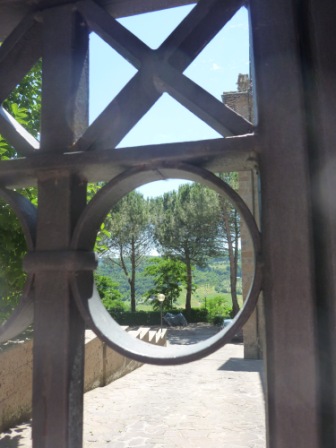
My Blog-break was in Italy. And very lovely it was too. Evenings, we lit candles in the Umbrian villa we’d rented with our group of friends. The first couple of days, there were dramatic rain storms and a lot of wind. The rest of the time, the weather was hot and getting hotter. Lovely. And there were stunning views, a garden full of flowers including my favourite Love In The Mist, and when we went visiting hill-top towns, there were intriguing sights to photograph. Plus gorgeous food.

Every now and then while away, especially in the evenings when we lit those candles, I thought about the little riddle I’d included in my last Blog.

The riddle:

How can you get fire wrapped in paper?

The answer:

The answer is obvious when you know it and most obviously satisfying when you see it made real, brought out in the form of an object. For the answer is a paper lantern. The candle inside is the fire. The paper around it makes the lantern.

The story:

So clever, so simple, the riddle plays a key part in a Chinese folk-tale I was told just before I went off to Italy. The teller was Nada, one of the excellent people on my Kensington Palace parents’ workshop. She’d found the tale in a picture-book version and had recognised it at once as a good story to tell. Besides, she’d taken the trouble not only to remember the story but to equip herself with a good-looking bag for the props that she’d prepared.

Out of this bag, at the appropriate moment, came a lovely Chinese lantern. And shortly after – for as you’ll see, a second riddle is also contained in the story – she brought out her second prop. This was equally simple, equally magical.

Read on and you’ll see what it was. (more…)

Storytelling Starters ~ Necklace of pearls

Saturday, March 30th, 2013

On Thursday four wonderful stories were told by participants on my Kensington Palace storytelling course for parents. I’ve mentioned some of the stories before. For me, the making of them was one marvellous element of the course. Other elements included my imparting some of the techniques of storytelling with Early Years children, such storytelling essentials as visualization and, of course, aspects of the history and life of Kensington Palace including the 18th century mural by William  Kent and other objects and paintings in the palace which in turn gave rise to our storymaking.

 All the stories we heard on Thursday were made up by the parents working in groups, all revolved around an object real or imagined and what follows is one of the four. It’s a Cinderella-type story and I hope I can do it justice. Its makers said they were willing for me to retell it but the retelling is in my own words.

The necklace of pearls

Once there was a king and a queen who had a son. When the son grew up, his royal parents decided it would be good if he got married. So they announced a great ball to be held at the palace. At the ball, they were thinking, he might meet a suitable bride.

After the ball was announced, there was a great deal of preparing. Extra people were brought to the palace to help – cooks, cleaners, hat-makers, musicians.

One person who was sent to help at the palace was a quiet, shy and good-hearted young girl. The job she was given was to assist with the cleaning. On the morning of the ball, she was sent to clean a particular room in which was a beautiful painting. The painting was of a lovely-looking woman with a little girl beside her who looked as if she was her daughter. Both the woman and the girl in the painting were wearing necklaces made of pearls.

But the painting was very dusty. The cleaning maid took out her duster and carefully started to dust it down. She began at the top – dusting, dusting, dusting – and it was when she came to the face that she experienced a very big surprise. As she dusted the face of the woman, the woman in the painting began to smile. Then as the cleaning maid continued, the woman’s necklace began to glow and slowly, gradually, it came out of the painting and clasped itself round the cleaning girl’s neck.

Just then, a strange creaking noise came from the wardrobe that was the only other thing in the room and when the maid turned round, she saw that the wardrobe’s doors had opened and inside was a most beautiful ball-gown. Then she heard a woman’s voice speaking. It was the woman in the painting. ‘You must put on this dress,’ the woman said, ‘and wear it with the necklace to the ball tonight.’ (more…)