Archive for the ‘Props and Resources’ Category
Saturday, October 29th, 2016
 This week, a query arrived from a storytelling friend (Hilary, this is you!). Among her storytelling stuff, she’d come across some clipped-together folded and cut papers. What could they be? She remembered they were connected with a story I’d once told her students. Something about a sea-captain? Could I remind her of it?
Now when it comes to blogging, I am a veritable infant. I love writing this blog, I know how to put in my pictures and I know how to post the blog each Saturday. Beyond that, I don’t know very much at all except I do also know how to look up stuff I’ve posted in this blog in the past. So I thought I’d pass on that information to anyone reading this now. If nothing else, it could be a useful reminder that you can use this blog as a kind of archive.
Storyworks Blog References
So. Look at the Search boxes on the top left of the blog. In the box marked Storyworks Blog References, put in a word or perhaps two that relate to a subject you might be interested in. Maybe you want to check up on a story you faintly remember reading here in the past. Maybe you’re interested in finding a new story on a particular theme – apples or ghosts or soul or wild man. If it’s something that’s been in this blog, the title and date of the relevant posting (or several) will come up on your screen when you’ve entered the word. Press on whichever one you want to check out and hey presto. (more…)
Tags: archive, Sally Tonge, sea-captain, The Captain's T-shirt, using this blog
Posted in Early years, Follow-up activities, Primary, Props and Resources | 1 Comment »
Sunday, July 24th, 2016
Last week’s story was The Swallowing Drum, the story of a girl called Ibanang. This week, I promised some ideas about telling and working with it. Before getting going, however, I must emphasise my belief that a simple, straightforward telling can also work very well. Often, however, participation is both appropriate and helpful for enriching the story and making it stick in its listeners’ minds. What follows are some well-tried ideas.
 Joining in with sound and action:
The drums Ibanang encounters on her way into the forest provide a brilliant opportunity. Pretend you are beating the drums with drum-sticks and repeat what the drums say a number of times and in different tones of voice – high for the little drum, medium-voice for the middle-size one, low for the big one. By the time you get to the middle-size drum – and I recommend leaving it to the children to join in when they want to – I can pretty much guarantee you’ll have your whole group doing the same as you.
If you know some kind of celebratory song, add it in at the end of the story when people are celebrating the end of the evil drum. And sing it several times over, with verve.
Getting children to volunteer their own ideas:
Some storytellers worry that the session will get out of control if you provide opportunities for children to say things in the course of the storytelling. Perhaps this is why some adults only ask very limited questions (eg do you know what colour of coat Red Riding Hood put on?) (more…)
Tags: drumming; talking; creating; Ibanang;discussing
Posted in Adults, Creating, Dealing with Stories, Folktales, Follow-up activities, Getting participation, Props and Resources | No Comments »
Saturday, July 16th, 2016
 A good story lasts and a good story travels. In the course of this week, I received a request from one of this blog’s readers. Steph who works in South London and whom I met at my Waterstones event a few weeks ago was asking for suggestions. She needs good hero/heroine stories for when she’ll be telling stories in a South London Primary school during Black History Month in October.
A Nigerian folk-story known as The Swallowing Drum was one suggestion that quickly popped up in my mind. The story was first introduced to me by my fellow storyteller, Karen Tovell. It’s brilliant for involving older-age, Key Stage Two primary pupils in participation, debate and story-creating. Adults in workshops, too, can get an enormous amount from it. Besides, there’s a fascinating tale to be told about how this story travelled from a telling of it I did in London to a large class of 11-12 year old children in one of South Africa’s black township schools. And, for me at any rate, the story raises an interesting question: Who is the heroine of this story – the mother or the daughter?
But all that is too much for one blog. So this week I’m simply retelling the story, reserving the rest for next week and perhaps the week after that.
The Swallowing Drum:
Once in a town called Ikom, there lived a girl called Ibanang. While her father went off to work on his land each day, her mother would sweep their hut, fetch water from the river and prepare their food. Then, when the father came home at mid-day, Ibanang’s mother would go off to work in the field while Ibanang’s father did all kinds of other jobs about their home and taught Ibanang how to weave.
Ibanang’s parents always had one important rule for Ibanang. They’d tell her she mustn’t go into the nearby forest – not on her own or without any grown-ups. Sometimes, families would go into the forest to collect wild honey or mushrooms. But Ibanang knew she mustn’t ever go there alone. Her friends’ parents said the same thing to them: Do not go into the forest on your own. But when the children were playing, they all used to wonder what could be in the forest that was such a problem. Wild animals? A witch? What could it be? (more…)
Tags: Abiyoyo, drum, forest, heroine, Key Stage Two, The Swallowing Drum
Posted in Folktales, Primary, Props and Resources | 2 Comments »
Saturday, July 9th, 2016
![Flag-of-Wales-thumbnail[1]](http://www.storyworks.org.uk/wordpress/wp-content/uploads/2016/07/Flag-of-Wales-thumbnail1-300x240.png) OK, I admit it. Over the last few weeks, I’ve become a devoted football fan. Obviously that’s because I’m Welsh and the Wales football team did so brilliantly in the Euros. It wasn’t easy seeing them get knocked out against Portugal in their semi-final this Wednesday. Yet, especially in this post-Brexit world, it’s an inspiration that the team believes so much in the strength of playing as a team, they pay such high regard to their fans and the support they get from them, they speak with such warmth of their country and they have been so good-humoured during their time away in France.
OK, I admit it. Over the last few weeks, I’ve become a devoted football fan. Obviously that’s because I’m Welsh and the Wales football team did so brilliantly in the Euros. It wasn’t easy seeing them get knocked out against Portugal in their semi-final this Wednesday. Yet, especially in this post-Brexit world, it’s an inspiration that the team believes so much in the strength of playing as a team, they pay such high regard to their fans and the support they get from them, they speak with such warmth of their country and they have been so good-humoured during their time away in France.
Besides, Gareth Bale is drop-dead gorgeous, both to look at and in his manner. I’m not sure I’ll keep following football as avidly now as I have been, but I’m sure I’ll be following him and the wonderful Welsh team.
It’s surely all this football stuff that caused a familiar phrase to pop up in my mind this week and with it the story from which it comes. The phrase is ‘extendable legs’. And the story it comes from is one I told in this blog on 21st July, 2012. To read a full version of it, you can look back at that blog posting. Simply fill in the words Chinese Brothers in the Storyworks Blog References slot on the top left side of the blog. Then press Search and up it will come.
The story itself is one children love to remember. An example occurred earlier this summer when I said to the two children in a family we know that I had a special story to tell them. Because the 10-year old sister is potty about mermaids, this was going to be a mermaid story. But somehow or other the promise of a story immediately made the 7-year old brother remember The Five Chinese Brothers which I’d told to them it must be three years ago. Volunteering that they still had the colourful Chinese pin-cushion I’d taken them as a present to go with the story, he started recalling the magic powers that are at its centre.
The Five Chinese Brothers: (more…)
Tags: Five Chinese Brothers, football; Euros; Gareth Bale; Cristiano Ronaldo, Wales
Posted in All ages, Body Stories, Folktales, Getting participation, Props and Resources, Uncategorized | No Comments »
Saturday, April 30th, 2016
 The Rajah with Enormous Ears is, deservedly, an extremely well-known story. One thing that intrigues me about it is the different versions that exist in other cultures. Did it travel to those places from India? Or did other peoples in other lands come up with the same idea?
In ancient Greece:
Perhaps the oldest version of the Enormous Ears theme occurs as part of the story of King Midas from ancient Greece. Here, Midas is punished with a pair of ass’s ears when he disagrees with the verdict in a famous musical contest. For a long time, he manages to conceal these big ears under a Phrygian cap. But his barber who is the only person aware of the secret cannot bear keeping it to himself. So the barber digs a hole in the river bank and whispers the secret into the hole. ‘King Midas has ass’s ears.’ Then the barber fills up the hole not knowing that, soon, a reed will sprout from the hole and whisper the king’s secret to all who pass by. When Midas learns that his disgrace has become public, he condemns the barber to death, drinks bull’s blood and dies a miserable death.
Tags: ear, harp, instruments, Labra the Mariner, March ap Meirchion, Midas, Rajah, reed, secret, The Rajah With Big Ears, tree
Posted in Body Stories, Folktales, Getting participation, Primary, Props and Resources | 3 Comments »
Saturday, April 16th, 2016
Cracking eggs into the mix for a fruit-cake yesterday morning, my thoughts turned to the current situation of a young friend. Suddenly I found myself thinking: ‘Don’t put all your eggs in one basket.’ So appropriate did the old saying seem to the circumstances I was considering that, as I added the flour to the mix, I began to remind myself of the story behind the adage.
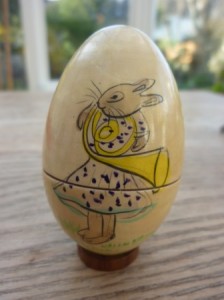 Don’t put all your eggs in one basket:
On a lovely Spring day, a lovely young country girl is tripping down the lane towards her local town, a basket full of eggs on her arm. And as she goes she is thinking. When she’s sold the eggs at the market – and she’s bound to sell them for they’re lovely fresh eggs – she’ll have enough money to spend, just enough, to buy a pretty new ribbon for her hair.
And when that pretty new ribbon is in her hair, she dreams, she’s sure it will please the boy that she fancies. The boy likes her already, she’s quite sure of that, but when her hair is bedecked with that pretty new ribbon, she’s sure he’ll like her even more. In fact, he’s bound to ask her out for a walk and, when he does, he’ll surely want to see her again and before long, she’s certain, he’ll be asking her to marry him. She knows she’ll say yes and she also knows that when they’re married, they’ll make a cosy home and have lots of children.
But it’s just here in her thoughts that this young girl trips. Oh no! It’s that tree-root sticking up out of the path that does it. Her basket goes flying, the eggs go flying and after she’s picked herself up, she is horrified to see that every one of the eggs is broken. So that’s it: no market, no sales, no ribbon, no lover, no marriage, no children.
Posted in All ages, Folktales, Personal experience, Props and Resources, Riddles, rhymes, sayings | 3 Comments »
Saturday, March 26th, 2016
The question comes up quite often and I feel privileged whenever it does. Usually it gets asked by someone in a Year 5 or 6 class who is therefore one of the older-age children in a Primary school. Almost always, a silence has fallen before it’s asked and invariably it’s asked in a quiet, thoughtful way. The question is: ‘Is that story true?’ On one unforgettable occasion, I’d just finished telling a most unbelievable Japanese story about a lazy liar who deserves a comeuppance.
A Japanese story: The Magic Nose-Fan
 One day, lolling under a bush, Kotaro is offered a magic nose-fan by a tengu who is a kind of mischievous Japanese troll-type figure usually recognisable by his very long nose. Our anti-hero accepts the nose-fan in return for the dice he’s been idly tossing about and it’s this same magic nose-fan that leads to the story’s final denouement in which Kotaro is left dangling off a far-distant planet, his little legs no doubt kicking around in the air.
What happens in between is that our anti-hero discovers that, when one side of the nose-fan is turned towards a nose, the fan will make the nose get longer. When its other side is turned nose-wards, it makes the nose get smaller again. With judicious use, it can return the nose to its normal size.
And how does our anti-hero make use of the tengu’s gift? Why, when he sees the local princess taking the air in the royal gardens, he wanders casually by and uses his fan to make her nose get long. Panic and pandemonium ensue. What is to be done? Doctors are called. Creams are deployed. Nothing works until our lazy no-good-boyo presents himself at the palace and, in a darkened room, returns the princess’ nose to its regular size. In return he gets to marry the princess as his reward and that enables him to lead an even lazier life than before.
But here comes the comeuppance. (more…)
Tags: Japanese story, Magic Nose-Fan, making fans, Pembrokeshire, question, tengu, true or not
Posted in Adults, All ages, Body Stories, Folktales, Managing problems, Props and Resources | 4 Comments »
Saturday, March 12th, 2016
Without response, where would we storytellers be? I’d probably shrivel like the dried-up brown leaf that was on my doorstep the other morning, blown there no doubt by the winds of the previous night.
 On Wednesday this week, I was at St Peter’s C of E Primary School in Ravenscourt Park. This was a new school for me except that its new head teacher used to book me at St Stephen’s School in Shepherd’s Bush where she previously worked. Some responses occurred in the course of the day which have stayed in my mind.
Identification
In my session for the Years 3 and 4 classes, I brought out my Rainbow Cloth (I often do). It brought some lovely responses, for instance that, if it transformed, it could become butterfly wings. I also told the story of how and where I’d bought it. ‘It comes from Africa,’ I began and in the small pause that followed, my eyes were drawn to two boys, both black, who were sitting together near the back. During my pause, one boy turned to the other, nodding slightly as if to say, ‘That’s like you.’ And at once, the other boy smiled with a look of such affirmation that I don’t want to forget it.
Tags: Bangalore, dragon, Rainbow Cloth, Ravenscourt Park, St Peter's, The Magic Tapestry
Posted in Adults, Folktales, Getting participation, Personal experience, Props and Resources | 5 Comments »
Saturday, February 27th, 2016
 This coming Monday, I’ll be at St Stephens Primary School in Shepherds Bush. They’ve asked me back over several years as part of their Arts Week and I’m looking forward to it. The children there really appreciate stories and among the ones I’m thinking of telling are some I’ve told to classes there in the past. (Children everywhere seem to love picking up on stories they’ve heard from you before).
One of the new tales I’m planning to tell is one I’ve hardly ever told before. Which age-group I’ll tell it with will depend on atmosphere and how things go at the time. First, let me give you an idea of the story. Then I’ll outline some of my thoughts on how and why I might tell it.
The characters of the story:
1. An old woman (very poor and very kind)
2. The Little Red Rooster (he belongs to the old woman) (more…)
Tags: Little Red Rooster, magic stomach, St Stephens Primary School, Sultan, treasure
Posted in Body Stories, Folktales, Getting participation, Preparing, Primary, Props and Resources, Visualisation | 4 Comments »
Saturday, December 5th, 2015
 Keep a storytelling notebook? It’s a good idea. It can become a little storehouse for all kinds of odd and wise sayings, proverbs, tongue twisters, thoughts and poems. I looked in mine the other day hoping to find the words of a song I simply couldn’t remember. Annoyingly, my notebook didn’t yield them. Even more annoyingly, I couldn’t find them anywhere else – not for ages and ages.
And meantime? I’d so much enjoyed going back through my notebook, I decided to pick out some of the things there for this week’s blog. I do hope you enjoy them. Even more, I hope you’ll find one or other item useful – perhaps as part of introducing a storytelling session, perhaps as a filler between two stories or maybe simply as an entertainment, something to say over supper.
So in no particular order (as they say on Strictly Come Dancing), here they are. And by the way, the photos accompanying them this week are of some very gorgeous art that has recently gone up on street walls near me – literally by the way.
A daft joke:
Two old women fell down a hole. Question: How did they get out?
Answer: One of them had a ladder in her tights. (more…)
Tags: poem, proverb, riddle, saying, storytelling notebook, street art
Posted in Adults, Personal experience, Poems, Props and Resources, Riddles, rhymes, sayings | No Comments »


![Flag-of-Wales-thumbnail[1]](http://www.storyworks.org.uk/wordpress/wp-content/uploads/2016/07/Flag-of-Wales-thumbnail1.png)


