


Storytelling Starters ~ Reflections on Telling and Writing 2
 It’s frog time. During the week, I saw several in the garden – one in a bucket of water and one in an empty pot right next to the kitchen door. (I hope you like my portraits of them below.)
More frogs!
One evening during the week, another frog was spotted sitting on its haunches in our study, looking for all the world as if it wanted to talk. When and how it got into the study we had no idea. It was me who was deputed to be the one to remove it. So I performed the usual trick of fetching a plastic bowl, popping it suddenly over the frog, then sliding a piece of card underneath, thus temporarily trapping the frog inside. Out in the garden, it hopped quickly away.
Next day my email inbox included a message from the artist who runs the Drawing Club in my local park. This week’s session, she announced, would be at the pond where we could have fun drawing the frogs: ‘Always the best session of the year!’
So frogs became the theme of my week. Last week I reflected on the writing of personal stories and some of the ways in which, in the writing, they differ from when you tell them. As a rule, the writing demands more context, more description, more elaboration. To return the stories to oral form, you have to unpick them somewhat – simplify them, shorten them, make them more natural.
All this is fairly obvious. The trouble is that we often start with an idea of what constitutes a story from the stories we see on the printed page. And the page doesn’t tell us that after unpicking a story we’d like to tell, we have to add to it again in the telling. The things we add are sometimes not even words and they’re often best when they are completely spontaneous, created on the moment in response to the audience. Improvised dialogue might be one example, facial expressions another. And what about the many different sorts of sounds the storyteller might come out with, for example the sound of a frog jumping? Describing such sounds as sound-effects makes them appear too studied.
They are often ad-hoc things and, of course, although there are some you might invent or practise while lying in the bath, others might emerge on the moment, almost of their own accord. One magic thing about storytelling is that it’s your audience that somehow draws them out of you.
So I decided that this week I’d tell you a very short tale and make a note of the sorts of additions I’d probably be making to the story if I was telling it now to an audience instead of writing it down.
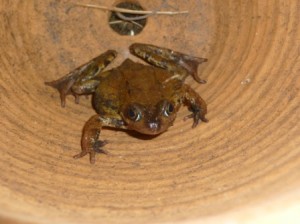 Jumping Frogs: the background
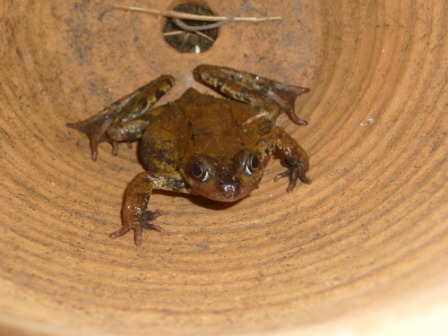
The story – and yes, it’s about frogs – was something that was told to me once in a storytelling workshop. It was an occurrence that had actually happened to the woman who told it. I’m breaking no confidences in telling it here.
It’s the sort of incident that, in the repeating, becomes the kind of tale we can all recognise from our experience or imagination. At frog time, it’s the sort of thing that happens.
Jumping Frogs: the story
(and what I’d be saying to introduce this story would depend, of course, on how it came up. If it was a workshop exercise, I might be saying, ‘You might also have a story like this.’ If it was a session with children, I could simply be saying, ‘It’s frog time. And I’ve got a true story about frogs to tell you!’)The woman in my story was in the kitchen one day when her two little daughters came in from the garden. The girls were very upset. ‘There’s a frog in the garden and it’s dead,’ they sobbed. (Here I’d probably be making sobbing noises and if my audience was children, I’d be hamming it up – but not too much and not too sad!)
The little girls’ mother was sympathetic. Her girls were sounding so upset! (Some spontaneous dialogue would almost certainly come in here. And if my audience was adults, it would try to appeal to their knowledge of the kinds of things you say to children – eg., ‘You know how you try to explain to children that it’s very sad that the frog is dead but at least it’s not feeling pain any more?’)
So the mother went out in the garden with her two girls and they all went and took a look at the frog. It certainly looked very dead. It was lying flat on the earth, unmoving. (But I might put those last sentences into the voice of the mother: ‘Oh poor frog, I think it really is dead. It’s not moving at all. And It looks so flat. Poor frog!’ Or if I kept the sentences in my own voice, I’d probably be pausing in between: The frog was all flat… It wasn’t moving at all … Not even one little bit!)
So the mother asked her girls if they should bury the frog.( ‘Shall we do that?’ ) Back in the house, she fetched her gardening gloves: she hated the idea of picking a frog up in her bare hands (here of course I’d add an Uuugh!) and she collected a couple of trowels. (And if my audience were children, I’d probably add, ‘You know, for digging!)
Back in the garden, the girls helped dig a hole. Then the mother said, ‘Now shall we bury the frog?’
So she put the gloves on her hands and bent over to pick up the frog. And it was then – can you guess what happened? (and here I’d be saying PHISH or WHEEP or some other completely invented sound of a frog jumping which would emerge on the spur of the moment, the volume and type of the sound depending on the atmosphere of the occasion and my audience) – the frog jumped.
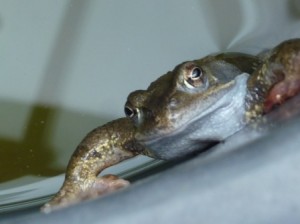 Jumping frogs – two afterthoughts:
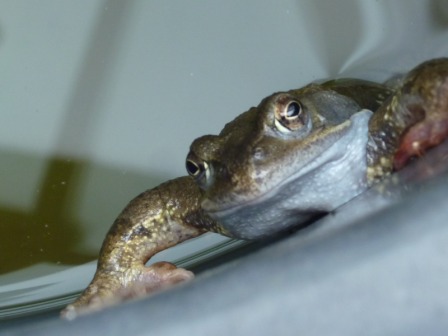
1. The above is the kind of tiny story I would often use as a preamble to the telling of a longer and more substantial folktale. After all, there are plenty of fascinating tales about frogs. One of my favourites is the Russian story of the Frog Princess. But – as they say – that’s another story.
2. It’s really worth practising frog-noises. The way I learned to do it was as follows:
i. Practice breathing in backwards. Do it quite noisily, then do it again while saying the first few letters of your ABC as if you’re dragging the letters into your breath.
ii. Next, while performing the same indrawn backwards kind of breathing, say either Rib It or Red It according to your choice. Allow the words to sound as guttural as possible. But don’t allow yourself to hurt your throat!
Next Week: Reflections on Telling and Writing 3
Links:
You can also read occasional blogs by me on the Early Learning HQ website. Early Learning HQ offers hundreds of free downloadable foundation stage and key stage one teaching resources. It also has an extensive blog section with contributions from a wide range of early years professionals, consultants and storytellers. For details of the Society for Storytelling, click here.
Tags: Creating atmosphere, getting your audience joining in, sharing a story, telling a personal story
March 17th, 2012 at 1:58 pm
Hi Mary!
This is a great site – can you tell me if i can receive this regularly?
best wishes
Pippa