


Storytelling Starters ~ More Games
 Got any storytelling games of your own to share? Please write in with your favourite. It would be great to hear about it. To me, storytelling games are invaluable – a vital part of the whole activity of storytelling and a fabulous way to get everyone relaxed. In my thirty years of storytelling, such examples as last week’s Desert Island became one of the strongest building blocks of my Storyworks approach. Here’s some reasons why:
- Storytelling games can be just the thing in a very wide variety of circumstances – with children in schools or community groups (parents learning about storytelling, adult with learning disabilities, elderly people in day centres, people getting together for a good time).
- They can be created (or recreated) to suit the themes of the stories to follow.
- They can allow everyone to participate at their own level.
- They give opportunity for individuals to express their own personalities, sharing their wit, humour and creativity in a totally unthreatening way.
In my Storyworks approach, (and I’m not talking here about the occasions when, as the storyteller, you’re being a performer in front of a sizeable audience), the storyteller is definitely NOT the be-all and the end-all and in NO WAY to be regarded as the only and most creative person in the room. The storyteller is the FACILITATOR, enabling the story or stories to become the centrepiece of the occasion and everyone present to share in the experience to the extent that they can and wish to do so.
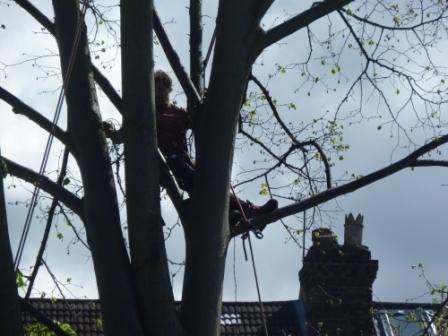
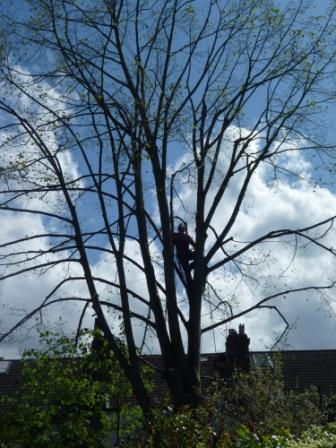
Last week when I wrote about Desert Island, I said I’d talk this week about some of the variants it has spawned. Here are some – and because trees or tree-cutting could fit so easily into these games, my illustrationsare some of my photos of the tree-cutting that was going on in my neighbours’ garden as I was writing:
There was an empty world
The format is the same as with Desert Island. Only the words are different: There was an empty world, And in that empty world, Mary put …? Music? Sam put …? Fatima put …? (Look back at last week’s blog to see the way the game builds up.)
Why these words can feel extremely right is that, when you’re sitting in a circle, the space in the middle feels like just that – an empty world. As it gets filled by people’s contributions, it literally feels like you are all creating a world to inhabit together.
Now here’s a slightly different format which is equally effective with children and adults in community groups:
 We went to the zoo (Or the farm. Or the toyshop. Or the supermarket. Or the forest)
We went to the zoo
And what did we see?
Mary saw … a monkey?
And Sam saw … a snake? Fatima saw … a fox?
Suitably modified, this game can be played with VERY YOUNG CHILDREN. Forget the alliterative matching of the name of the person whose turn it is to the item or object that is contributed. Just add animals as the children think of them. Mary found a lion. Sam found a cow. Fatima found a rhinoceros. (The addition of the animal’s sound each time can add a lot to the fun!)
Or with very young children, have a basket with little toy animals inside. Pass the basket round. As each child in turn takes an animal out of the basket, that animal’s name gets added in to the game.
Now here’s another variation:
We’ve come to the workshop
We’ve come to the workshop
And now that we are here
Mary does some …? Music-making?
Sam does some …? Sawing?
Ceri-Ann does some …? Cleaning?
Tom does some …? Tree-cutting?
The brilliant thing about this particular format is that it can work superbly well with people who cannot or don’t want to talk. This is because they can act their contribution (and in my experience, the acting happens quite spontaneously and, moreover, it both helps and inspires people to speak as the whole group catches on to what is being done.)
So in this game, enactment should be a central feature. As the facilitator, make sure everyone realises this by starting your own first contribution with a suitable gesture. As the game builds up, you then get a longer and longer sequence of gestures or enactments – which makes it all very active and fun.
 My Experience:
On one occasion when I introduced The Workshop Game with a group in Stratford East (it was a group that consisted of a mixture of adults with mental health problems and adults with learning disabilities), the game – AMAZINGLY – became so productive and such a founding feature of our work together that, over subsequent weeks, it was constantly referred to. It also provided one of the central ideas of a brilliant show we all put together and put on for other groups in the area. The title of the show – THE DEAD DOG SHOW – arose from another of the games that we played, The Transformation Game. (See next week). But the scene for our show was HAROLD’S HOUSE because Harold, who was one of our group, had said HOUSE when it came to his turn the first time we played The Workshop Game. I’d quickly turned this into ‘Harold is taking us to his house.’ And Harold’s house still feels important and welcoming to me today. More on that next week …
Next Week: The Transformation Game
Links: You can also read occasional blogs by me on the Early Learning HQ website. Early Learning HQ offers hundreds of free downloadable foundation stage and key stage one teaching resources. It also has an extensive blog section with contributions from a wide range of early years professionals, consultants and storytellers. For details of the Society for Storytelling, click here.
Tags: facilitator's role, getting participation, There Was An Empty World, We Went To The Zoo, We've Come To The Workshop