


Storytelling Starters ~ ‘Who’s there?’
I’m still reading Emily Dickinson’s poems. There are an enormous number – 1775 in all – and they require pondering. Apart from the fact that their punctuation is eccentric, their meaning is often ambiguous and all the richer for that. The poem below is a story poem, which is why I decided to make it the subject of this week’s blog. It has made me think a lot about the differences between the language of poems and the language of told stories.
The language of poetry is condensed, rich in metaphor and image in a way that the storyteller’s language rarely is. Told stories have specially chosen details that alert the mind, turns of phrase that please the ear. They have momentum and also at times a kind of ambiguity that makes you wonder what is going on. But the two modes are different. At the end of the Emily Dickinson poem here, the door of the house is open. It’s early morning. The sun is just rising. But who or what has opened the door? Did robbers really come and leave it open? Or is it the sun that has opened the door, perhaps not literally but to our attention?
 Poem 289
I know some lonely Houses off the Road
A Robber’d like the look of –
Wooden barred,
And windows hanging low,
Inviting to –
A Portico,
Where two could creep –
One – hand the Tools –
The other peep –
To make sure All’s Asleep –
Old fashioned eyes –
Not easy to surprise!
How orderly the Kitchen’d look, by night,
With just a Clock – But they could gag the Tick –
And Mice won’t bark –
And so the Walls – don’t tell –
None – will –
A pair of Spectacles ajar just stir –
An Almanac’s aware –
Was it the Mat – winked,
Or a Nervous Star?
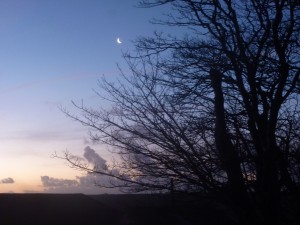
The Moon – slides down the stair,
To see who’s there!
There’s plunder – where –
Tankard, or Spoon –
Earring – or Stone –
A Watch – Some Ancient Brooch
To match the Grandmama –
Staid sleeping – there –
Day – rattles – too
Stealth’s slow –
The Sun has got as far
As the third Sycamore –
Screams Chanticleer
‘Who’s there?’
And Echoes – Trains away,
Sneer – ‘Where?’
While the old Couple, just astir,
Fancy the Sunrise – left the door ajar!
PS: That’s it. And don’t you just love the idea of the moon sliding down the stairs to see who’s there?
Tags: Emily Dickinson, language of poetry, language of told story
July 12th, 2017 at 12:56 am
Mary I found this very interesting. I read poetry frequently and recently we had the honour of Carol Ann Duffy visit us in my local town I find her links to Story especially the Greek legends profound.
i agree poetry does not waste words it does create an image.
Poetry and story are different but I also believe they are similar too.,that as tellers we can leave the door open.
We can repeat a phrase to strengthen the story.
We can use just a few word to create an image an atmosphere.
Did you know Jay O ‘Callahan USA.has produce a one man performance on the life of Emily Dickinson .
I spent a lot of time with him in his master storytelling workshops.
He know how to link poetry and story.He never waste a word.
Kind regards.Lesley
July 12th, 2017 at 3:02 am
Hello Mary.
I do like the way you explain the difference between poetry and storytelling.
(I’ve been wondering about Spoken Word Poetry, after an article I read, and how close it is to telling a story.
I do hope you’ve seen the movie “A Quiet Passion.” I snuck off one Monday morning to see it and came out feeling I’d been to the moon and back!
She was portrayed as such a complex character, brave and vulnerable, expressive and shy at the same time!
So thank you for this poem. Love ‘the sun has gotten as far as the third sycamore’
And the Moon coming down the stairs, I see as clothed in white samite … like the female Moon in the Fenland story, The Buried Moon.’ I do need to read more of her poems and they have to be to hand, in a book.
Kind Regards, Meg