Mary Medlicott, Storyteller and Author - Storyworks

Archive for the ‘All ages’ Category

Storytelling Starters ~ Magic of Objects

Saturday, March 16th, 2013

You know a story is working its magic when a listener says they were really inside it. That’s what child after child reported this Wednesday in one of the classes where I was telling stories at St Stephen’s Primary School in Shepherds Bush. I’d asked them what they’d felt during a story I’d told them. ‘As if I was in it.’ ‘Like I was there.’ ‘I felt like it was happening to me.’

The same kinds of thing were said on Thursday at Session 3 of the Parents’ Storytelling Course at Kensington Palace. The parents on the course are a terrific group of people, all of them mums except for one dad. One said this week, ‘This storytelling course is really changing my life.’ It was the greater depth of their response to the world around them that several had noticed – like they were going more deeply into the things around them. One had done lots of Internet research on historical personages linked with the palace. Another is now bringing some of our storytelling techniques into the nightly storytelling she does with her children.

‘It makes them really involved,’ she said. ‘My son is aged nine. Now he is paying more attention.’

Making things happen (more…)

Storytelling Starters ~ Inspiration

Saturday, February 9th, 2013

Where to begin? First, because St Valentine’s Day happens next week, I’m offering some background information on the name of the day together with the suggestion that you bend your mind to looking up a love story to tell. Plus – as you can see from my photos – I’ve got a suggestion of something to make which could form a really great prop for your story, not least because it could also lead to some enjoyable craft work on the part of your audience.

Equally importantly, I have a couple of thoughts related to two great comments on last week’s blog that arrived during the course of this week. Both are from people I know and admire. Both show the kind of passion for storytelling and its effects that, in my view, has a much wider bearing on how we all approach our lives.

St Valentine’s Day

First,  St Valentine’s Day. I’ve been looking up some background. Did you know – I didn’t! – that St Valentine was a priest of Rome who was martyred for succouring persecuted Christians? Why his saint’s day, 14 February, has become a symbol of romantic love is perhaps connected with the love he showed his fellow human beings.

But because of the link between the days, it appears that St Valentine’s Day also reaches much further back into the story of ancient Rome. There, the festival of the Lupercalia used to occur around 15 February. It involved the wild rampaging of youths on the streets and also the giving of presents.

 Zestful energy? Hormones surging? The mating of human beings? It all seems to be part of St. Valentine’s Day. Hence also another old association – with the mating of birds.

A Valentine Heart

Now here’s that prop that you can make. (I actually don’t love the term ‘prop’.)

As in the photo to the left, cut out two paper shapes that look like small, tall loaves of bread. The ones in my photo are 80 mm wide and, excluding the top rounded bit, 80 mm long. Your shapes could be bigger or smaller according to your preference.

Next, as on the right, cut up towards the rounded part of each paper to make six separated legs. With a larger shape, you could choose to have more strips or, with a smaller shape, fewer. Experiment is all. Next: (more…)

Storytelling Starters ~ Duck

Saturday, January 19th, 2013

On Thursday this week, there was ice. I went with my camera to Brockwell Park . The mid-day sun had turned the surface of the bigger pond into kaleidoscopes of sparkle and glitter. Ducks and Canada Geese and seagulls and moorhen were taking deliberate steps across the ice like little old men with sticks. Where ice had melted, they lowered themselves gingerly into the water and paddled about. When pieces of bread were thrown towards them – for several people arrived with bags of it – there’d be a sudden great flapping of wings and huge cacophonies of cawing as the birds rose up, chasing each other to the food.

Ducks

‘Ducks,’ I was thinking. ‘Ducks …’ The image must have been stirring my thoughts. For when I was on my way home, my brain suddenly dived back to a snapshot image that I remembered from an old story. It was an image of one or two ducks turning head down, tail up, diving for something deep below the surface and bringing up beakfuls of mud.

Snapshots from stories can display a powerful tenacity, lingering in the sub-conscious for years until something happens to reanimate them. (This is, of course, one of the reasons why stories are so important to humans, feedings our brains, creating connections.) But what was this story with its image of ducks? (more…)

Storytelling Starters ~ Cam Ceiliog

Saturday, January 5th, 2013

The stride of the cockerel may not be massive but it’s certainly very determined – a purposeful strut! And that’s why I love the Welsh phrase, cam ceiliog.

Ceiliog means cockerel, cam is a step or a stride, and cam ceiliog describes the way in which the light draws out after the Winter solstice. It happens by small but sure degrees, not in one giant leap. At this time of the year – and Happy New Year by the way – you really begin to notice the change. After the darkness of late December, and perhaps with the resoluteness of the New Year spirit, you start to notice the earlier light in the mornings, the evenings going on longer. ‘Cam ceiliog’ does it as the mother of one of my schoolfriends always used to remind us. She was a very positive woman.

That link between the cockerel and the coming of light is an appealing association. I remember the cockerel’s distinctive doodle-doo-ing from childhood mornings on my grandparents’ smallholding. I remember it too from more recent times, for instance on holiday in the Sierra Tejeda in Spain. The wake-up call would sound out round the village (and sometimes, because it recurred all day, it would finally become exasperating).

Stories that link us to the earth and its creatures

I love associations between human beings and nature. To me, they’re one reason why we could do worse at the start of a year than remind ourselves of the numerous stories that link us to the earth and its creatures. For where would we be as humans if we lost a sense of those links? For one thing, we’d be at risk of losing a proper sense of the richness of this planet and our place as one – but only one – of the species that inhabit it. (more…)

Storytelling Starters ~ New Year Reflections

Sunday, December 30th, 2012

Happy New Year! Blwyddyn Newydd Dda!

 Here’s one of my favourite photos from 2012.

It’s just a photo of water – but water full of colourful reflections and beautiful patterns. 

It comes with my very best wishes for 2013.

May you have the best of health.

And the best of friendship, new stories and prospects.

See you then.

Mary xxx

(more…)

Storytelling Starters ~ Season’s Greetings 2012

Saturday, December 22nd, 2012

Last Sunday afternoon, I went to a lovely gathering given by fellow storyteller Helen East. The party was to celebrate her new book of London Folk Tales published in the History Press series which, area by area, is gradually aiming to cover the stories of the entire country.

Helen’s story: St Uncumber

At Sunday’s gathering, Helen told one of the stories in her book – the story of St Uncumber, a once very popular saint who was regarded as the protector of women stuck in bad marriages and possibly hoping to disencumber themselves of them.

In Helen’s story, a poor boy fiddler wandered into old St Paul’s, where there used to be a wooden statue of St Uncumber, and began playing his fiddle in front of the carving. As he played with all the feeling he could muster, the wooden woman began to tremble and come alive. Soon she was swaying wildly in rhythm to his playing until, finally, she bent down, slipped off one of her golden shoes and tossed it to the fiddler, as if to thank him for his music.

But when the fiddler went out of the church, people who saw him carrying the golden shoe mobbed him and accused him of stealing it. Before long, he was being tried, found guilty of robbery and sentenced to death. Thankfully, his accusers acceded to his wish that first they accompany him back to the wooden statue. When they got there, the little fiddler played again. For a long while, the statue did not respond. But when she did, everything happened just as before until she finally bent down, slipped off her other golden shoe and tossed this, too, at the fiddler.

It’s a very delightful story and it was finely told by Helen accompanied by music from her partner, Rick Wilson. Please buy Helen’s book to read it and other London stories from Helen’s amazing store of rare and unusual tales.

Uncumbering

May Helen’s book sell well. And may we all, this Christmas, feel we can ‘uncumber’ ourselves in the sense of putting aside our woes and our worries and remembering all the good things of life.

Wonders of nature

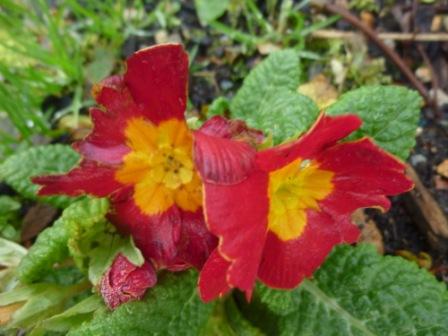
PS: Talking of gold – as in St Uncumber’s shoes – the little red and gold polyanthus in the photo above is currently in full bloom in my Welsh garden despite all the wind and the rain. 

Down the road, the gorse bush to the right was one of several in golden blossom yesterday against a grey and rain-filled sky.

Happy Christmas Everyone! (more…)

Storytelling Starters ~ Wintering Out 3

Saturday, December 8th, 2012

Two more Seasonal Tales today – seasonal because of the star in the Christmas story and because I always think stars look especially wonderful at this dark time of the year. Today’s Seasonal Tales are two different versions of the Star Apple story.

The Star Apple Story ~ what you need

The Star Apple Story is a great one for telling at a family event or in school. All you need as props are an apple and a knife to cut it. As long as you adapt the story appropriately, the apple can be red or green as you choose and in the version of the story that appears first below (I posted it in this Blog last year, but it’s worth repeating) the apple should also have a good strong bit of stem.

Star Apple ~ Version 1

Once there was a little boy who was very excited in the days before Christmas. Was it going to snow? Would Father Christmas come to his house? What would Father Christmas bring him?

The little boy was so excited, he didn’t know what to do. ‘What shall I do?’ he kept asking. The Christmas decorations were already up. His old toys bored him and  he’d tidied his room as his mother had suggested. ‘What shall I do?’ he asked again.

That’s when his mother said something weird. ‘Why don’t you look round the house and the garden and see if you can find a little green house with no windows but a chimney on top and a star inside?’

‘UH?’ The little boy was mystified. He looked round the house. He looked round the garden. Nowhere at all could he find a little green house with no windows but a chimney on top, and a star inside. ‘Mum,’ the boy said, ‘I can’t find it.’

Then his mother suggested he call on his friend next door: the two of them together could go down the street and see if they could find it. So that’s what the little boy did. He and his friend looked at all the houses. They could see some that had stars inside on top of their Christmas trees and some of the houses had chimneys. But none of the houses had no windows and none of them were green.

The little boy went back to his own house.‘Mum,’ he said, ‘we didn’t find it.’

‘Well, let me show you,’ said his mother, reaching a little green apple out of the fruit bowl.

‘See,’ she said. ‘here’s a little green house. And look,’ she said, wiggling the stalk on the top, ‘this little green house has a chimney. But it hasn’t got any windows, has it?’

‘No,’ said the boys. ‘And where’s the star?’

‘Just watch,’ the little boy’s mother replied as she picked up a knife and cut the apple cross-wise across the middle. When she opened it up, the little boy and his friend could see that it had a beautiful star inside.

‘And now,’ said the mother, ‘you can eat the apple, half each.’

‘And can we do the story again every day until Christmas?’

‘Yes,’ said the mother, ‘we can. And tonight when it’s dark we’ll go out on the street and see if we can see the stars in the sky.’’ (more…)

Storytelling Starters ~ Wintering Out 1

Saturday, November 24th, 2012

The evenings are getting darker and I’m starting a new series of postings. Wintering Out is the title and it starts with Dark, Dark Tale, a Story Chant that’s great with children and also with adults as a piece of fun in workshops. Next week and in the run-up to Christmas, I’ll bring other seasonal tales and chants into the mix.

Storytelling in Education: good news and bad news 

But first, to continue my recent theme of Storytelling in Education, let me give you my week’s good news and bad news. Both came in the same email from a Literacy Adviser in Pembrokeshire for whom I’ve done loads of work in the past, including a series of extended teacher courses. On one of those courses, now quite a few years ago, I told the Pembrokeshire legend of Skomar Oddy and I remember how much it appealed to one of the teachers. The children in her class  loved this particular story and she based lots of writing and art work on it.  Well, my Literacy Adviser’s email told me that when she recently went into that school, there was a whole new fresh display on the Skomar Oddy story. This was music to my ears. It shows that teachers who fall in  love with storytelling can make really good use of it year after year and that a good story never goes out of fashion.

The bad news was that, in these current times, there’s no longer any central funding in Pembrokeshire for the kind of storytelling in education work that I did so much of there. It’ll now be down to individual schools. That’s it – at least until people realize once more how important it is to fund this kind of work! Another worrying and retrograde step.

Dark, Dark Tale: a Story Chant for Winter

Once upon a time there was a dark dark wood.
In the dark dark wood, there was a dark dark path.
Along the dark dark path, there was a dark dark gate.
(Shall we go in through the gate?)

Behind the dark dark gate was a dark dark garden.
In the dark dark garden, there was a dark dark house.
In the dark dark house, there was a dark dark door.
(Shall we go in through the door?)

Behind the dark dark door, there was a dark dark hall.
Along the dark dark hall, there was a dark dark room.
In the dark dark room, there was a dark dark box.
(Shall we open it up?)

Oh my goodness! What was that? (more…)

Storytelling Starters ~ Body Stories / Hand

Saturday, August 4th, 2012

As Olympic gold medals mount up for Britain,  my favourite body-parts story has come back to my mind. It’s a story about the way the different body-parts connect and how all of them have to work together. But they cannot function properly as a unit without the operation of thought. I don’t know if the story has a title (told stories rarely do!) but here I’m calling it Give Me a Hand.

Give Me a Hand: the background

Where I heard Give Me a Hand was at an Australian Aboriginal storytelling concert at the South Bank in London some years ago. The concert was an event to accompany a major exhibition of Australian art at the Hayward Gallery.

The Dreamtime paintings of Australian Aboriginal painters are bold and beautiful and very earthy.  They feel very connected to the earth we inhabit and at the same time they give a very real sense of what makes the Australian earth unique. Listening to the stories at that South Bank storytelling, it began to feel like the stories themselves were creating the landscape.

The two storytellers were women on that special occasion. What ensured that I’d never forget it was that, towards the end of the concert, they suddenly announced that they were now going to hold a public mourning event. At first, I had no idea what this could possibly be. Members of the audience were invited to come up on stage if they wished to join in and then the keening began. It  had a spine-chilling quality which at first I found extremely uncomfortable. I felt terribly excluded from it. Then I began to understand.

The mourning, as the storytellers explained it, was for those members of their peoples whose bones had ended up in museums in England. Their wish was that the bones be taken back to Australia so they could be properly buried. Suddenly I realised what this was all about. To the museums that held them, the bones were of archaeological and anthropological importance. To the Aboriginal peoples, they were the remains of real people – remembered relatives such as aunties, great-aunties and great-grandparents.

So here’s the story, Give Me a Hand. Of course, when I heard it, I imagined it happening in the Australian bush as conjured up in the Dreamtime paintings. The words of my telling may not do that for you. But however you visualise it, I think you’ll agree that the story is striking. (more…)

Storytelling Starters ~ Nature Stories

Saturday, June 30th, 2012

Well, the photos this week are of birds – three of a pigeon in Venice plus a picture out of my photo archives of seagulls over the Thames.

But the theme of the words is not just birds but cuckoos.

Why cuckoos?

A while ago, a good friend of mine who is also a storyteller got me interested in sponsoring a cuckoo. To do what, you might very well ask? The answer is that the British Trust for Ornithology is keen to find out why cuckoo numbers in Britain have been on the decline and why cuckoos from Scotland and Wales have been doing rather better than cuckoos from England. So they’ve been tagging cuckoos and, by tracking them on the fantastic journeys they annually make from the UK, down across Europe into Africa and back again to where they set out, they are hoping to discover what problems the different cuckoos face.

Last season, I sponsored an English cuckoo who’d been awarded the name of Kaspar. Alas, he didn’t return from the 16,000-miles or more that  these cuckoos normally travel. This season I’ve sponsored a cuckoo from Ceredigion  in Wales who is yet to be awarded a name. I’ve written in, along with many others, to suggest what name might be chosen for him.

My suggestion is Taliesin. Taliesin was one of the earliest Welsh poets. He lived in the second half of the 6th century and I’ve often told audiences the magical legend about him that appears in the Mabinogion.

Taliesin still sings, I said in my email, and hopefully the soon-to-be-named cuckoo will sing for a long time too.

I recommend the BTO website. Like the tree-sign in my last week’s blog, the material on cuckoos (and other birds too) is a story in itself.

A cuckoo legend:
By tradition, it’s on April 7th that the first cuckoo’s song of the year is heard each year in Pembrokeshire which is my native part of Wales. The 7th April is St Brynach’s Day and, in the village of Nevern where St Brynach eventually settled after making a pilgrimage to Rome and spending some years in Brittany, people would wait for the cuckoo to come and fly down to the old Celtic Cross that is St Brynach’s Cross. And it’s there, they say, that the cuckoo would sing.

One year, the bird was late arriving. Waiting eagerly for it to come, the priest was reluctant to start the service until he’d heard the cuckoo’s song.

Eventually the gathered congregation saw the cuckoo fly down through the trees in the churchyard and settle on St Brynach’s Cross. But the bird looked terribly battered and tired and, after singing for one brief, glorious moment, it fell from the cross and died. (more…)