Mary Medlicott, Storyteller and Author - Storyworks

Archive for the ‘All ages’ Category

Storytelling Starters ~ Plotting

Saturday, November 23rd, 2013
A few weeks back now, after an evening with a group of friends, one of them sent me a very nice email. It said he’d really loved a story I’d told and that he’d love listening to me even if I was just reading a shopping list. I was properly flattered and suddenly reminded of a couple of ideas I’d come across once when looking into memorisation techniques.

The ancient Greek technique

One idea from ancient Greece is an exercise for remembering a group of items. You start by mentally associating each item with an object in a room that you know. You have to really focus, making each association as intense or funny or fantastic as you can. After you’ve done that, you should be able to remember your group of items whenever you want to. Just take a mental walk round that room. As you catch sight of the objects in it, the associations you made should flood into your mind – and with them the items you wanted to recall.

The Shopping List Story

The shopping list technique is similar except that it involves creating a story. Perhaps you’re about to go shopping and you haven’t got any paper to make a list. Or maybe you’ve just got vast holes in your brain like I sometimes have these days. (It’s age!) Don’t panic. Mentally assemble the items you want to remember to buy and then start devising a story that connects them up. It can be any kind of story – as ludicrous, fantastical or realistic as you like. The activity could be a fantastic exercise for a class of children (aged about 7 or upwards?) Or equally satisfying with a gaggle of grand-children (Liz – could this be one for you?) Or maybe it’s just what is needed if you’re on your own (in bed with a cough).

Give it a whirl!

This week I’ve had plenty of time. The cough I’ve had for nearly three weeks suddenly became absolutely pernicious and I’ve have had to spend more than one day in bed. Boring. So I got out the two shopping lists my friend had sent me after I’d emailed him back. I hadn’t told him why I was asking him for a shopping list. I’d just said it was for a project I had in mind. Kindly, he sent me two. One was a list of ingredients for a Christmas cake. The other was an ordinary sort of list consisting of 17 different items.

Sitting in bed, I set about my story which I intend as a kind of present for him. I didn’t do much with the Christmas cake list – too long and complicated. But I didn’t entirely ignore it either. Come back next week and I’ll tell you what resulted – or part of it at least. Meantime why don’t you also give it a go? The full 17-strong list is below. If you’re doing it with a class of children, you could always suggest they select just three or four items for their storymaking.

The Shopping List:

Milk….Eggs, medium….Butter, unsalted….Orange juice….Cucumbers….Carrots….Green beans….Lemons….Limes….Diced stewing steak….Cream cheese….Andrex toilet roll….Persil non-bio washing powder….Dettol antibacterial surface cleaner….Stainless steel polish….Vitamin C/Zinc tablets….Tea tree and Mint shower gel

PS: Good luck!

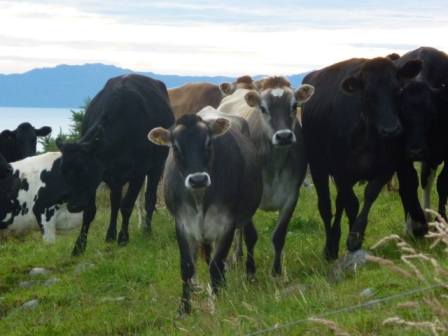
Photos this week are pretty obvious. Cows to represent milk (and, yes, I’ve chosen these particular cows because they were the  most fetching I’ve ever photographed and in the most fetching place in New Zealand). And wooden eggs to represent real eggs (and isn’t it lucky they’re wooden since our cat takes the greatest pleasure in pawing them off their little dish whenever he jumps onto my desk). (more…)

Storytelling Starters ~ Time to tell

Saturday, October 26th, 2013

Do I dare call myself a storyteller? Hallowe’en is a popular time for storytelling. Yet I absolutely hate Hallowe’en – not because of the spectres, witches, zombies and demons but because of the commercialisation. Fancy-dress clothes get hired, kids run round knocking on doors, then look at you blankly when you appear, not sure what to say or quite why they’re there.

Baba Yaga

I don’t like Hallowe’en but I like Baba Yaga, the ugly old hag of Russian fairytale. She seems entirely the sort of ambivalent character we could do well to remember at this time of the year. A creature who inhabits the shadows, she lives in the depths of the forest in a hut with chicken legs that spins endlessly round. To get in to the hut, indeed to survive Baba Yaga at all, you have to know the correct thing to say. According to Afanas’ev, the Russian story-collector, she uses her very long nose to poke the fire and her sharpened iron teeth to devour young, tender victims.

But it’s often possible to outwit Baba Yaga. In fact, sometimes you feel she’s got something extremely insightful about her – for if you have courage and a good, kind heart, she ultimately respects it and will spare you. And when she spares you, you will afterwards be all the stronger for it.

HAG

Last week, I encountered Baba Yaga when I went with one of my god-daughters to see a play called HAG at the Soho Theatre in London. Produced by The Wrong Crowd company, the play generally followed the pattern of Vasilisa the Beautiful, one of the most well-known of Baba Yaga stories. It made strong use of puppets but was by no means aimed at young children. From its hilariously satirical approach to the stepmother character and her two mocking daughters (these were shown as a bodiless, twin-headed puppet), I could sense how it would appeal to the teenage audiences for whom it’s apparently at least partly intended. The play’s main character is a sweet-natured girl whose mother has died. With so heartless, vain and cruel a stepmother, she has in consequence to face some of the worst demons this world can throw up.

Coming out of HAG, it was particularly nice to encounter a large group of young women who, it turned out, had been brought to see the play by their English teacher. They had obviously got a lot from it.

So let me recommend Baba Yaga stories for audiences young and old. Plenty can be found on the Internet and, for young children, there are a number in picture-book form. In these, quite suitably for the age-group, Baba Yaga is usually presented simply as a witch who has to be fled. HAG reminded me that Baba Yaga’s significance can be more complex and, as such, her appeal far wider.

And meantime remember your clocks …

Yes, do remember to turn your clocks back on Saturday night or Sunday morning.

I well remember the occasion when Paul and I were in Italy on holiday and, over several days towards the end of our holiday, were surprised to notice that our hotel dining room was virtually empty each time we turned up there for dinner. Not until the morning that we left did we understand why.

Because of the earliness of our departure, we’d organised with the hotel-owner the night before that he would be up early in the morning to sort out our bill. We got up. He wasn’t there. Indeed, he had to be sent for and when we finally saw him coming up the road, he was still doing up his trousers and repeatedly calling out ‘Mama Mia’ in a long-suffering voice as if he couldn’t quite believe what these mad British people were up to. Shortly afterwards, we realised why. Days before, the clocks had gone back. We’d been completely oblivious.

Got any similar stories? The theme’s a good one for story-sharing. (more…)

Storytelling Starters ~ Stone

Saturday, August 17th, 2013

A surprise contribution to this blog arrived this week from Jean Edmiston, my friend and long-term colleague as a storyteller. Jean lives and works in her native Scotland these days so I don’t get to see much of her.

But we often speak on the phone about stories, storytelling and our common approach, which is to believe in how stories can empower imagination for everyone if they are approached in a sharing way. Below is what Jean wrote.

The bag of pebbles (more…)

Storytelling Starters ~ Little worlds

Saturday, August 10th, 2013

You often come across them on beaches: little worlds that have been lovingly made and left to their subsequent fate by their creators. These little worlds may be excavated pools surrounded by sand-castles and carefully decorated with shells, pebbles and feathers.

Or they may be Stonehenge-type arrangements of rocks. Or maybe, amazingly, lifelike figures created from an arrangement of stones.

I remember making such things as a child.

Fairy pools

So it was a great delight this week to come across a little world in the very process of being created down at Pwll Strodyr, our favourite tiny Pembrokeshire cove. Hardly anyone goes to Pwll Strodyr, which is one of the reasons we love it.

This week, on a beautifully warm early evening, a man and a woman and their young daughter were there. ‘We’re making fairy pools,’ said the man when we greeted him as we arrived. ‘That’s nice,’ I replied. ‘It means you could get some fairies visiting and they’ll probably bring some luck.’

When I went swimming a little while later, I was careful to collect some long strands of green seaweed which I offered to the little girl as mermaid’s hair. (more…)

Storytelling Starters ~ August days

Saturday, August 3rd, 2013

August days are times to relax, take your shoes off, go for a swim. They’re also times off for your mind, opportunities to notice things in a different kind of way, mull them over and allow the seeds of a story to sprout in your mind.

Years ago, Paul and I went on holiday to the isles of Mull and Iona. We were intrigued, on Mull, by the number of mail-boxes we passed. Again and again there they were on the road-side at the turn-off to farms and houses. Contraptions where the postman could leave people’s post, they came in different colours, shapes and sizes. Many looked like little houses. We couldn’t help noticing and commenting on them. In a flash, Mr Beaton existed.

The mail-box story (more…)

Storytelling Starters ~ Fire and wind

Saturday, June 22nd, 2013

My Blog-break was in Italy. And very lovely it was too. Evenings, we lit candles in the Umbrian villa we’d rented with our group of friends. The first couple of days, there were dramatic rain storms and a lot of wind. The rest of the time, the weather was hot and getting hotter. Lovely. And there were stunning views, a garden full of flowers including my favourite Love In The Mist, and when we went visiting hill-top towns, there were intriguing sights to photograph. Plus gorgeous food.

Every now and then while away, especially in the evenings when we lit those candles, I thought about the little riddle I’d included in my last Blog.

The riddle:

How can you get fire wrapped in paper?

The answer:

The answer is obvious when you know it and most obviously satisfying when you see it made real, brought out in the form of an object. For the answer is a paper lantern. The candle inside is the fire. The paper around it makes the lantern.

The story:

So clever, so simple, the riddle plays a key part in a Chinese folk-tale I was told just before I went off to Italy. The teller was Nada, one of the excellent people on my Kensington Palace parents’ workshop. She’d found the tale in a picture-book version and had recognised it at once as a good story to tell. Besides, she’d taken the trouble not only to remember the story but to equip herself with a good-looking bag for the props that she’d prepared.

Out of this bag, at the appropriate moment, came a lovely Chinese lantern. And shortly after – for as you’ll see, a second riddle is also contained in the story – she brought out her second prop. This was equally simple, equally magical.

Read on and you’ll see what it was. (more…)

Storytelling Starters ~ Very Short

Saturday, June 1st, 2013

Have you ever felt overwhelmed with far too many different things to do? That’s how things are with me right now. So today’s Blog is very short.

Riddle:

How can you get fire wrapped in paper?

The answer:

The answer is in an excellent story that was told last week by one of the parents on my Kensington Palace course.

I’ll tell it to you soon.

Next week and the following week, I’m taking a Blog-break. See you again on 22nd June. (more…)

Storytelling Starters ~ Key

Saturday, May 25th, 2013

Problem: storytelling in schools is in decline.

Question: what can be done about it?

This week I’ve been given some good ideas. Here’s one.

Response Archive:

The Response Archive idea was sent to me by Hilary Minns of Warwick University. It involves noticing, then noting down, key moments in children’s responses to oral stories they’re being told. The children can be of any age. The responses could happen either during the telling or after in the course of some talk or activity following the telling.

Recording the responses would be a way of beginning an archive of evidence about the value and benefits of storytelling in education. This is greatly needed in my view and Hilary and others agree.

Example: The Gingerbread Man

Here is the example Hilary sent me of the kind of responses that might be captured for the Response Archive. One  student on her storytelling module at the University recently told her class the story of The Gingerbread Man. Afterwards the student role-played being the Gingerbread Man. The children came up with questions. These are the questions they asked:

Why did you run out of the house?
How did you escape from the oven?
How come you were real when you were made out of playdough?
How did you get on the fox’s tail?
Why did you trust the fox?
Did your leg hurt when the fox bit it off?
What was on the other side of the river?

Good, hey? The questions demonstrate how keenly the children had listened to the story and how intelligently they were thinking about its implications. For anyone of the view that these days, it’s difficult to get children to listen, think and speak, let alone be creative, the example could be key.

Action: (more…)

Storytelling Starters ~ To inspire

Saturday, May 18th, 2013

The essential point of any storytelling workshop or course is to inspire and impart – not to disempower. Participants can be enthused in different ways and with diverse outcomes. They may become tellers of stories in their family lives. They may start telling, making and hearing stories with people they work with. They may even conceive the ambition to develop themselves as professional or semi-professional storytellers.

Palpable excitement

On Wednesday and Thursday this week, I felt particularly conscious of this multi-faceted effect. On Wednesday, I was at Warwick University doing one of my annual sessions with students on Hilary Minns’ storytelling module for people working with children. Thursday was the final session of my Kensington Palace course for parents. Both times, I felt the palpable excitement of people who have already started to experience the effects of their storytelling on children. And not only children. One Kensington Palace mother read us a story she’d written during the week. Beautifully written it was too. During the course, she told us, she felt she’d discovered a new facility for writing. She reported how affected her husband had been by this.

New skills, new confidence, new powers of invention: the KensingtonPalace crowd will, I feel sure, go on to great things. Already they are well into planning storytelling clubs for the children in the schools their children attend. I have offered my help in getting these going.

As for the Warwick University students, they’ll soon be planning and writing their end-of-course dissertations. In doing this, they will be using and recording their own new awareness of the effects of stories on children.

Leading workshops – a particular skill

But it’s an important point to make: leading workshops in such a way as to produce these effects is a particular skill of its own. I know I’m good at it (I should be by now!) and of course I know it’s not the only way of working as a storyteller. (I love the other ways, too.) But it does require a particular set of qualities – knowing how to put participants at their ease; activities that can involve all in the group, including the shyest; a storytelling style that does not show itself off but encourages people to feel they can do it too; a way of working that recognises and develops people’s individual interests, skills and styles. And last but not least, a love of employing and sharing the ‘secrets’ of the storytelling art.

The need today

It’s a tall order. And it represents one of my current concerns about what’s happening with storytelling in education today. Right now, we badly need more storytellers who want to foster this way of working so there can be more parents, more teachers and more childcare workers spreading the joys and wisdoms of storytelling. Is enough happening to fund this kind of development? Are enough people aware of the need? What happens if and when this kind of workshop-running dies out? (more…)

Storytelling Starters ~ Contrast and Connection

Saturday, March 23rd, 2013

Contrast and connection are this week’s themes. On Wednesday when my husband Paul returned from his trip to Australia to go to his godson’s wedding, the huge contrast in temperature – 29 degrees down to 2 – was just one aspect of what we talked about. Looking at his photos – sunny beaches, a kangaroo with baby in pouch, the vegetation – I felt highly aware of the massive contrasts he’d experienced in culture, landscape and general style of life.

One detail that particularly struck me was his description of the feel on his hand of the delicate claws of a kangaroo mother.

The power of touch

Then, Wednesday evening, I had my own extraordinary experience of touch. In a workshop at the Interfaith Centre in Queens Park, the participants were asked to spend ten minutes talking in pairs (five minutes each) about how we are involved in narrative work. A crucial factor about the results for us all was that, as requested, we’d each spoken to each other with eyes closed, hands touching. It made us all highly aware of the essence of the other.

Connection! That Wednesday evening experience was part of the second Forum event arranged by St Ethelburga’s Centre for Peace and Reconciliation. Since conflict resolution is the very specialised field of work of a number of those who were present, I sometimes felt conscious of the comparative ordinariness of my 30-years of work as a professional storyteller working in schools and with groups of adults. Yet the very next day, back at Kensington Palace for Session 4 of my parents course in how to tell stories, I felt once again conscious of the extraordinariness of it – how, because of the people, it is full of meaning and value. And also, always, a sense of potential.

Points of connection

Here are some of the things I experienced on Thursday.

1. During a synchronised retelling of one of the stories I’ve taught to the group (Mrs Wiggle and Mrs Waggle), I became extremely aware of the big, beautiful eyes of a tiny toddler who had been brought along by his mother. My voice, my face, the story, the atmosphere? Whatever it was that engaged him so much, the little toddler was gripped. He sat looking up at me with such attention, it felt entirely obvious that he knew what was going on, and that in some way it was entirely for him. Connection!

2. With another bigger boy – a four-year old also there with his mother – I saw at once from the way he joined in, though often looking at her not at me, that the story was already familiar to him. So I knew his mother must have told it to him. I was delighted. It’s one of the aims of the course – to get parents telling stories to their own and other children. Connection!

3. During a break in the session, one of the Arabic-speaking mothers showed me a lovely jewellery box she’d brought in from home. She also showed me part of the story her 8-year old daughter had created and written about it. I got the sense that this story was something very new for the girl: her teacher in school had evidently been very impressed by what she’d done. For my part, I was impressed by the mother. Last week, we’d used the magic of objects as an inspiration for making new stories. She’d clearly passed on the magic and in so doing had engendered another example of the potency for change that can arise through story. Connection! (more…)