


Storytelling Starters ~ Focus
 Performance and how you do it – that’s been a focus of a lot of my thinking and talk this week. For one thing, the Annual Gathering of the SfS (Society for Storytelling) took place last Saturday. I couldn’t be there myself but I heard that performance vs story-sharing was a particular theme of discussion. Not surprising: it goes to the heart of what storytelling is and can be which is a timely and urgent issue in the storytelling world.
For another thing, my husband Paul is currently taking an Advanced Singers’ Performance Course at Morley College. On Tuesday this week, along with other singers from the course, he took part in a lunch-time recital. He sang three songs and, though I say it myself, he was brilliant. He stood well, he engaged his audience and he sang with real feeling and a beautiful tone. Back at the house, before and after, we talked about every aspect.
Stance:
In performance, singers stand. Storytellers either stand or sit according to individual preference and the type of performance. In any staged setting, standing is usual. If your choice as a storyteller is to sit, you’re giving your audience some of the feel of the fire-side traditions of storytelling, which can be extremely effective. But in a larger situation, it limits your ability to project.
What you do with your stance is important. Some storytellers enact parts of their story. Some – which is rather different – make frequent use of dramatic gesture. For myself, though I’m inclined to use my hands a bit too much, what I aim for is the same quiet relaxed stance that is recommended for the singer. This enables the focus to be on what is being communicated rather than the communicator. It’s an aspect of story-sharing which, I believe, can and should be part of performance.
Look:
Where do you turn your gaze when you’ve got an audience before you? That’s another vital question. Making eye-contact is a powerful tool for both the singer and the storyteller. Yet it can be over-used. For some audience-members, it can be intimidating.
As a storyteller, you immediately notice which people in an audience are looking at you directly and with a willingness to engage. (Adults, unlike children, often do not look in your direction at all, preferring to go into their own world. This can be disconcerting.) My practice is very much to respond to people that are looking at me but to try also to be conscious not to get too hooked onto any one person’s engagement.
I also recommend a bit of dissembling – finding a place in the audience where you can direct your gaze, as though at someone in particular, but not actually so. Instead, you’re looking in between the faces, somewhere in the middle distance, but in a lively way as though focusing your whole audience into one ideal listener who is there but not present.
Feeling:
Feeling is vital but it does have to be felt. Simulated feeling is showy. It’s where, in my view, performance ceases to engage. For me, it needs to come from the heart. It needs to be thought and felt.
Beauty of tone:
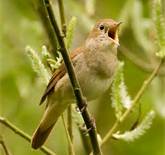 On Friday this week, Simon Jenkins in the Guardian wrote about the nightingale (which, like the cuckoo, is in serious decline in this country due largely to loss of habitat). He wrote about the sheer beauty of the nightingale’s song, as if it sings for the pure joy of singing. Paul and I heard one once on the island of Iona: we stood right by the tree where it sang and listened to it for ages. We walked on and when we returned it was still singing.
There’s something in the nightingale’s song for storyteller and human singer alike to aim at: a voice that can be easily heard and where every bit can be heard, a tone that does not distract by being scratchy, unpractised or forced and a love of the doing where the beauty is what flows out.
P.S. Sadly, Session 6 of my Kensington Palace parents’ course, which was due to happen on Thursday this week, had to be postponed (health issues on the part of the organiser). It was to have been our Reflections session where we would also talk about what next. Fingers crossed, it will happen in May.
April 21st, 2013 at 8:48 pm
I’m delighted to be teaching my storytelling module once again for undergraduate students at Warwick University. This year there are 20 students, and the group is made up of classroom assistants, nursery teachers, a student who works with families at a Children’s Centre, and a childminder. I have discovered that between them the students speak seven languages other than English, and I hope they’ll be brave enough to tell us all stories from their own cultural traditions in their preferred language before the course is over. One of the highlights of the module is our annual visit from Mary Medlicott. Her workshops with the students are inspirational and leave us all with a ‘rosy glow’, as my mother used to say.
Throughout the 10 weeks of the module I shall be introducing the students to a range of stories from across the world and we’ll be investigating ways of choosing stories, learning stories and telling stories to children. We’ll also be exploring why stories are such a vital part of children’s learning and development. This is so important at this particular moment in time when young children, through no fault of their teachers, are increasingly being fed an unremitting diet of phonics, spelling, punctuation and grammar. There is little time left, of course, for finding out how language really works when children talk, listen, read and write as they tell their own personal stories and retell those they love. Hence the importance of Mary’s website with its focus on the pleasure of language and the stimulation of storytime – thank you, Mary.