Archive for the ‘Remembering’ Category
Saturday, February 20th, 2016
 Yesterday I spent a good part of the day on a train coming down to Wales. The reason for my trip? I’ve been invited to a 100th birthday celebration lunch. The person who has reached such a wonderful age lived with her family at the end of my street when I was growing up. Her husband ran the chemist’s shop on the corner. We children played with her children.
On the train, I was reminded of a piece of writing I did recently – not about birthdays but about being on trains. I don’t know if you find the same kind of thing when you’re on a train (and I think it’s not the same on buses or planes or in cars). My mind goes into itself. Often I find myself thinking about a story and that’s what I wrote about. I’d be fascinated to know if any of you who may read this blog have the same kind of experience.
Train-world dreaming: (more…)
Tags: 100th birthday, Maryland, Reflections, thinking, train
Posted in Adults, Personal experience, Preparing, Remembering, Telling and Writing, Visualisation | No Comments »
Saturday, February 6th, 2016
 You could play it as a game. ‘Associations’ you might call it. For instance, let’s start with the word ‘cloud’. Playing ‘Associations’, I might come up with the fact that I once knew a girl called Cloud. (‘What a beautiful name,’ I used to think.) Then again, each day when I open up my computer, on comes one of those irritating dialogue boxes: KnowHow Cloud. (‘Have you logged in to Cloud?’ it persists in asking.) Or am I remembering the Afrikaans saying I quoted here a few weeks ago: ‘And all the time we are being carried like great clouds across the sky.’
I don’t know what associations you’d put forward. Maybe you have none for Cloud. But as a storyteller, I do think it’s useful sometimes to stop and wonder. ‘ Why? What associations do I have with that story? Why do I like it so much? What is it about it that attracts me? Why am I so compelled to tell it?’
Following suit, I must ask myself why, towards the end of this week, I remembered a little story about a cloud I was once told? And why did I start thinking about it? Was it simply because I was walking down the street wondering what I’d write about today and happened to notice a distinctly shaped cloud in the sky? More than likely. Dense grey skies have been over our heads so often here in London lately (and here, thinking about what it may be like elsewhere, I must send special greetings to the growing number of readers of this blog who live far, far away, in Australia, New Zealand, India, Brazil). When the sky is one dense grey mass, there are none of those separate clouds where you might see particular colours and shapes. ‘Look, do you see the dog in the sky?’ ‘And what about that great bird on the wing!’ Or could that cloud be a boy?
The Boy Who Became A Cloud (more…)
Posted in All ages, Folktales, Personal experience, Remembering | 6 Comments »
Saturday, September 5th, 2015
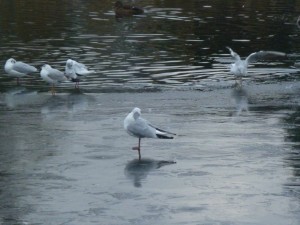 In the depths of the ocean lived a king. (What was his name? I don’t remember.)
The king longed for company. He lived all alone. (Had he ever had a wife or children?)
One evening as he rode out on one of his tides, the king became aware of sweet sounds of music and, looking up at a house by the sea, he saw two lovely young women sitting in the firelight playing their harps.
A longing grew in the heart of the king until one late evening on a high Autumn tide, he rode out of the sea on his finest white horse, rushed to the girls’ house and snatched them away together with the harps they were playing. (Were the girls alone when he did that? What were they called?)
When the king of the ocean had brought the two girls into his palace beneath the waves, they first felt fear, then became very sad. They missed their home. They missed the bright light of day. The king of the ocean would ask them to play him their music, but the music they made for him lacked any joy.
After much sadness and pleading, the king of the sea knew this couldn’t continue. He must show pity. He must listen to the two young women he’d seized and return them to their home on land. But when his white horses brought them in from the sea, just as they stepped onto the land, they changed. (Did the king of the sea command that to happen? Or did the pity that the girls felt for him play a part?)
As they stepped out of the sea, the two lovely girls became transformed. (more…)
Tags: herring gull sculpture, migrants, seagull, Thames path
Posted in All ages, Folktales, Personal experience, Remembering, Symbolism | 2 Comments »
Saturday, June 27th, 2015
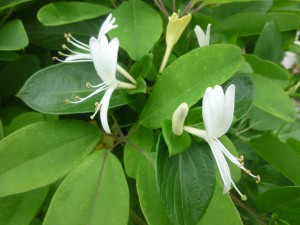 I wish I could encapsulate the honeysuckle growing in the next street from me and somehow include it in this blog so you could smell it as you read. Maybe some day that’ll become possible. Meantime Iron-Age forts have been on my mind.
Why Iron-Age forts? Because next Monday I’m doing some storytelling training for guides at Castell Henllys, the Iron-Age fort in North Pembrokeshire. It’s the only such place which today has roundhouses on the exact site of the ones that were there back then.
The length of time:
What strikes me, thinking about that long-ago time is the very length of the time from then to now. And how can you possibly get that across? Almost as hard as electronically encapsulating the honeysuckle, the challenge reminds me of how I once had to try to make a class of 10-year old Stevenage children conscious of Ancient Egypt at the same time as taking into account their other current project – Ourselves Now.
Miraculously – for the results were fantastic – I got the idea of giving the children some sense of the passage of time by coming up with memories from each year of their lives and then creating hieroglyphs to represent them like the hieroglyphs from Ancient Egypt they’d already been learning about. This led on to them making memory charts and this then led to them telling their personal stories and deciding (this was entirely their own idea!) to punctuate each of the 10 years for which they had stories with the sound of a gong.
What the Iron-Age had: (more…)
Tags: 10-year olds, Castell Henllys, chant, honeysuckle, Iron-Age fort, Pembrokeshire, Stevenage
Posted in All ages, Chants and songs, Follow-up activities, Personal experience, Remembering, Themes | 8 Comments »
Saturday, May 9th, 2015
 In folklore, bears are the harbingers of Spring and last weekend, visiting friends in Berlin, I saw a good many of them. Like the painted elephants that appeared all over London in the summer of 2010, these were extremely colourful creatures. Unlike the London elephants, which disappeared at the end of the summer when they were auctioned off for charity, the Berlin bears are there to stay. The bear. after all, is one of the symbols of the city and they are among its new emanations.
Bear stories
Covered in slogans or embellished with pictures, upside down or arms raised in a wave, the Berlin bears kept reminding me of bear stories. One I recalled while walking around is a foundation myth of the Modoc Indians of California. A very touching story, it tells how the little daughter of the Great Spirit is peeping out of the mountain in which they live when a great wind catches at her hair and blows her out of the mountain. After sliding down the snowy side of the mountain, the little girl ends up being found and raised by a mother bear. When she is grown, she marries one of the mother bear’s sons. Their children become the Modoc people.
But alas, when stories are prompted, it’s not always a matter of remembering them fully. One of the curses of the storyteller is sometimes being plagued by half-remembered things, flotsam from stories that, once encountered, are no longer there in your mind. Back in London, I’ve had to try and catch up. One question that was bugging me had been prompted by my favourite among the Berlin bears, the blue one painted with signs of the cosmos. Wasn’t there a constellation or two that represents bears? And the answer, of course, is yes. It’s a story that occurs in Greek mythology. (more…)
Tags: bear, Bear Skin, Berlin, Greek myth, Modoc myth, Thinking about memory
Posted in Adults, Folktales, Myth and Legend, Personal experience, Remembering, Symbolism, Themes | 2 Comments »
Saturday, March 14th, 2015
 What makes children sit up and listen?
What makes children remember what they’re told?
What makes children respond and comment without being obliged to do so?
Well, storytelling does. The trouble is, if you’re reading this blog, you probably already know the truth of that. It’s how to spread the awareness that is the problem.
All day this last Wednesday came evidence of how children can listen and be gripped. The supply of questions and comments was fulsome and never chaotic (evidence of a good school, I’d say). But the most extraordinary thing was how, all day, children were remembering stories I’d told them before. From Reception to Year 6, there was enormous keenness not just to identify what stories they’d heard but exactly what happened in them. They also remembered my props. And it wasn’t just one or two children that were doing this, just about all of the children were bursting to say what they remembered. Only the Nursery children didn’t – but then, they were new to the school.
The school was St Stephen’s in Shepherd’s Bush. I’d been there three times before. In the course of this week’s visit, one girl in one session put her hand up looking troubled. ‘I can’t remember these stories,’ she said. It obviously really bothered her that she didn’t, as if she was feeling really hurt that she’d missed out on something everyone else had experienced. We thought perhaps she’d been off school when I’d come before and she seemed content with that thought. But seeing her face, I realised the power of a communal event in which everybody can share and experience enjoyment. (more…)
Tags: Arabian Nights, Golden Water, Richard Hughes, Singing Tree, St Stephen's, Talking Bird, The Glass Ball
Posted in Folktales, Performance, Primary, Remembering, Storytelling in Education | 2 Comments »
Saturday, February 14th, 2015
So here’s the third of my blogs about that beautiful story from the Arabian Nights which I’m preparing for telling in a fortnight’s time. The first blog gave a brief idea of the story as I’d remembered it over a number of years. The second itemised the three treasures in the story that I’d completely forgotten about. Now here’s the main body of the story. I’ve simmered it down to its bare bones. That’s how I work when I’m starting from a written story. Visualisation must do the rest. Here goes.
The set-up:
 Farizad and her two brothers, Farid and Faruz, live in the beautiful garden which was created by the gardener and his wife who were their parents.
Now the parents have died.
One day an old woman comes to the garden and says to Farizad: This garden is beautiful but it would be perfect with 3 rare treasures – the Talking Bird, the Singing Tree and the Golden Water. Farizad asks where these can be found? In the mountains on the road into India.
Farizad says she must go and find them. Farid and Faruz say, ‘No, we’ll go.’ But then they agree that one brother must stay to look after Farizad.
Quest of Brother No. 1 (more…)
Tags: Arabian Nights, Farizad, knife, pearls
Posted in Adults, Folktales, Preparing, Primary, Props and Resources, Remembering, Visualisation | 1 Comment »
Saturday, May 10th, 2014
Last week, I was so chilled out – or rather, so warm and relaxed – on holiday on the island of Lanzarote, that I felt I had nothing to say. By today, I’m positively burning to go on about the value of personal links. After all, we’ve all got them in one form or another.
Good days, personal links:
 One of our best days on Lanzarote involved a visit to an astonishing Cactus Garden. Another was a pilgrimage to the house of José Saramago, the Portuguese writer and Nobel Prize Winner who spent the last 18 years of his life on the island. Both days arose because of personal links, the first because, back here in London, my husband has an amazing collection of cactuses, the second because a very good friend of mine was Saramago’s English translator and, because of her, we have read his books.
Personal links create that extra degree of interest which can make you bother to take journeys, actual and symbolic. I became doubly aware of the truth of that this week when my main task and pleasure has lain in preparing the talk I’m to give next Monday to the Historical Society in St David’s. The society was founded by my father and the link with him is one reason for my sense of anticipation.
Shemi the storyteller (more…)
Tags: cactuses, D. J. Williams, father, Lanzarote, Saramago, Shemi, St David's
Posted in Adults, Personal experience, Personal Tales, Preparing, Remembering, Symbolism, True tales | No Comments »
Saturday, March 15th, 2014
 It’s arrived. Storytelling for a Greener World is an important new book about how to engage people in our natural environment through stories and storytelling. The official launch date is April 11th and the foreword is by Jonathon Porritt of Friends of the Earth. The inspiration came from Alida Gersie and a wide range of storytellers provide the contents. The essay I feel privileged to have contributed is on the effects on teachers and children of working with a Pembrokeshire legend about the Preseli hills.
Storytelling for a Greener World is meticulously designed to provide a really helpful, inspiring resource. For details for buying it, see below.
My key word:
The key word for me is engagement. I increasingly realise it’s why I do what I do. Again on Wednesday, I felt its impact when spending the day at St Stephen’s Primary School in Shepherds Bush. The children remembered. They remembered me, they remembered my stories. I’d been there last year in their Arts Week. I’d gone there again a few weeks ago on their special day for celebrating stories. Now on Wednesday, their wish to let me know that they remembered came out strongly in all the groups, none of them more than the youngest. The little red monkey, Matty Treweller, Nokomis of the great rain … characters and themes from stories they’d previously heard from me were called out with great joy as each session began. It felt like the children were keen for me to realise that we’d already established a common bond through participating together in the world of story.
Where there’s been one story, there’s always another. (more…)
Tags: Alida Gersie, engagement, Jonathon Porritt, Pembrokeshire, St Stephens Primary School, Storytelling for a Greener World
Posted in Adults, Personal experience, Remembering, Storytelling in Education, Uncategorized | No Comments »
Saturday, November 23rd, 2013
 A few weeks back now, after an evening with a group of friends, one of them sent me a very nice email. It said he’d really loved a story I’d told and that he’d love listening to me even if I was just reading a shopping list. I was properly flattered and suddenly reminded of a couple of ideas I’d come across once when looking into memorisation techniques.
The ancient Greek technique
One idea from ancient Greece is an exercise for remembering a group of items. You start by mentally associating each item with an object in a room that you know. You have to really focus, making each association as intense or funny or fantastic as you can. After you’ve done that, you should be able to remember your group of items whenever you want to. Just take a mental walk round that room. As you catch sight of the objects in it, the associations you made should flood into your mind – and with them the items you wanted to recall.
The Shopping List Story
The shopping list technique is similar except that it involves creating a story. Perhaps you’re about to go shopping and you haven’t got any paper to make a list. Or maybe you’ve just got vast holes in your brain like I sometimes have these days. (It’s age!) Don’t panic. Mentally assemble the items you want to remember to buy and then start devising a story that connects them up. It can be any kind of story – as ludicrous, fantastical or realistic as you like. The activity could be a fantastic exercise for a class of children (aged about 7 or upwards?) Or equally satisfying with a gaggle of grand-children (Liz – could this be one for you?) Or maybe it’s just what is needed if you’re on your own (in bed with a cough).
Give it a whirl!
 This week I’ve had plenty of time. The cough I’ve had for nearly three weeks suddenly became absolutely pernicious and I’ve have had to spend more than one day in bed. Boring. So I got out the two shopping lists my friend had sent me after I’d emailed him back. I hadn’t told him why I was asking him for a shopping list. I’d just said it was for a project I had in mind. Kindly, he sent me two. One was a list of ingredients for a Christmas cake. The other was an ordinary sort of list consisting of 17 different items.
Sitting in bed, I set about my story which I intend as a kind of present for him. I didn’t do much with the Christmas cake list – too long and complicated. But I didn’t entirely ignore it either. Come back next week and I’ll tell you what resulted – or part of it at least. Meantime why don’t you also give it a go? The full 17-strong list is below. If you’re doing it with a class of children, you could always suggest they select just three or four items for their storymaking.
The Shopping List:
Milk….Eggs, medium….Butter, unsalted….Orange juice….Cucumbers….Carrots….Green beans….Lemons….Limes….Diced stewing steak….Cream cheese….Andrex toilet roll….Persil non-bio washing powder….Dettol antibacterial surface cleaner….Stainless steel polish….Vitamin C/Zinc tablets….Tea tree and Mint shower gel
PS: Good luck!
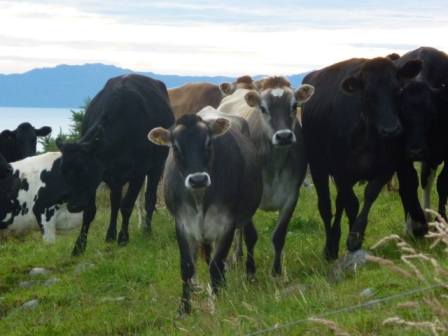
Photos this week are pretty obvious. Cows to represent milk (and, yes, I’ve chosen these particular cows because they were the most fetching I’ve ever photographed and in the most fetching place in New Zealand). And wooden eggs to represent real eggs (and isn’t it lucky they’re wooden since our cat takes the greatest pleasure in pawing them off their little dish whenever he jumps onto my desk). (more…)
Tags: ancient Greeks, memorisation, shopping list
Posted in All ages, Creating, Personal experience, Remembering, Storytelling games, Visualisation | No Comments »


 Yesterday I spent a good part of the day on a train coming down to Wales. The reason for my trip? I’ve been invited to a 100th birthday celebration lunch. The person who has reached such a wonderful age lived with her family at the end of my street when I was growing up. Her husband ran the chemist’s shop on the corner. We children played with her children.