Mary Medlicott, Storyteller and Author - Storyworks

Archive for October, 2013

Storytelling Starters ~ Time to tell

Saturday, October 26th, 2013

Do I dare call myself a storyteller? Hallowe’en is a popular time for storytelling. Yet I absolutely hate Hallowe’en – not because of the spectres, witches, zombies and demons but because of the commercialisation. Fancy-dress clothes get hired, kids run round knocking on doors, then look at you blankly when you appear, not sure what to say or quite why they’re there.

Baba Yaga

I don’t like Hallowe’en but I like Baba Yaga, the ugly old hag of Russian fairytale. She seems entirely the sort of ambivalent character we could do well to remember at this time of the year. A creature who inhabits the shadows, she lives in the depths of the forest in a hut with chicken legs that spins endlessly round. To get in to the hut, indeed to survive Baba Yaga at all, you have to know the correct thing to say. According to Afanas’ev, the Russian story-collector, she uses her very long nose to poke the fire and her sharpened iron teeth to devour young, tender victims.

But it’s often possible to outwit Baba Yaga. In fact, sometimes you feel she’s got something extremely insightful about her – for if you have courage and a good, kind heart, she ultimately respects it and will spare you. And when she spares you, you will afterwards be all the stronger for it.

HAG

Last week, I encountered Baba Yaga when I went with one of my god-daughters to see a play called HAG at the Soho Theatre in London. Produced by The Wrong Crowd company, the play generally followed the pattern of Vasilisa the Beautiful, one of the most well-known of Baba Yaga stories. It made strong use of puppets but was by no means aimed at young children. From its hilariously satirical approach to the stepmother character and her two mocking daughters (these were shown as a bodiless, twin-headed puppet), I could sense how it would appeal to the teenage audiences for whom it’s apparently at least partly intended. The play’s main character is a sweet-natured girl whose mother has died. With so heartless, vain and cruel a stepmother, she has in consequence to face some of the worst demons this world can throw up.

Coming out of HAG, it was particularly nice to encounter a large group of young women who, it turned out, had been brought to see the play by their English teacher. They had obviously got a lot from it.

So let me recommend Baba Yaga stories for audiences young and old. Plenty can be found on the Internet and, for young children, there are a number in picture-book form. In these, quite suitably for the age-group, Baba Yaga is usually presented simply as a witch who has to be fled. HAG reminded me that Baba Yaga’s significance can be more complex and, as such, her appeal far wider.

And meantime remember your clocks …

Yes, do remember to turn your clocks back on Saturday night or Sunday morning.

I well remember the occasion when Paul and I were in Italy on holiday and, over several days towards the end of our holiday, were surprised to notice that our hotel dining room was virtually empty each time we turned up there for dinner. Not until the morning that we left did we understand why.

Because of the earliness of our departure, we’d organised with the hotel-owner the night before that he would be up early in the morning to sort out our bill. We got up. He wasn’t there. Indeed, he had to be sent for and when we finally saw him coming up the road, he was still doing up his trousers and repeatedly calling out ‘Mama Mia’ in a long-suffering voice as if he couldn’t quite believe what these mad British people were up to. Shortly afterwards, we realised why. Days before, the clocks had gone back. We’d been completely oblivious.

Got any similar stories? The theme’s a good one for story-sharing. (more…)
Storytelling Starters ~ Awarded

Saturday, October 19th, 2013

It was a wet and windy night. Yet in Milton Keynes last Saturday, October 12th, inside the Creed Street Arts Centre in Wolverton, the welcome was warm and hospitable. We were there for the award-giving Ceremony for this year’s BASE awards.

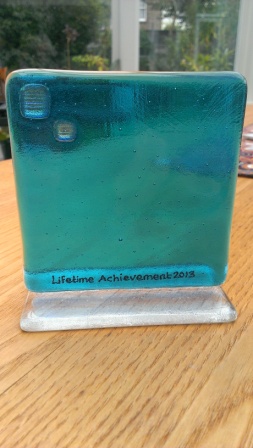
Lots of people had come. Shonaleigh and Peter Chand hosted. A great Spoken Words Artist, Richard Frost, acted as compere for the evening. Stories were told, awards were given, acceptance speeches made. Last up, I was made the delighted recipient of this year’s Lifetime Achievement Award. As on every day since by the emails and phone calls that have followed, I felt extremely touched and honoured.

What I’m most pleased and proud about is that the Award feels like a recognition of the particular approach to storytelling that has been mine now for 30-odd years. It’s an approach I share with many others and it forms the basis of this weekly blog. I describe it as a sharing approach where, whatever the kind of storytelling occasion, be it a performance to adults or a session with Under-5s, the storyteller is in one way or another reaching out to others and in so doing acknowledging the truth that we all have stories inside us. Some stories we may not like to hear. Some may need help to be told. Some will be well told, some very badly. Some can be acknowledged only in the listening. But no single storyteller has all the stories or all the ways of telling them. Stories are our common wealth and I love and treasure the telling, the listening and the sharing.

P.S. Lots of people have asked what I got. My photo displays the answer. I hope it gives you an idea of the loveliness of the blue. (more…)

Storytelling Starters ~ BASE Awards

Saturday, October 12th, 2013

This evening I’m off to the BASE Awards event in Wolverton. And if you don’t know where Wolverton is, it’s right next to Milton Keynes.

Ancient Egypt and Us

Milton Keynes is a resonant place-name for me. I once worked with a brilliant class of 10-year olds there. One of the topics in their class at the time was Ancient Egyptians. The other was Ourselves. Their teacher wanted a project to bring the two topics together.

Of course, it’s possible to tell stories from Ancient Egypt. I did – and the children loved them. But how is it possible to imagine the length of time that has passed since the Ancient Egyptians existed? These children certainly couldn’t. Like most children of their age, they had little sense at all of time passing. So I came up with the idea of a Memory Chart on which each child would use hieroglyphs of their own design to notate one memory for each year of their lives so far. We made an exception for their first four years: most people have few recollections from that period. So those years, we decided, could be lumped together and occupy just one box in each person’s chart.

Memory work

The children were brilliant. When we did the initial memory work, there was a lot of jotting down, telling and retelling of what had happened. Then came the making of the memory charts. Each person creating their own, the hieroglyphs designed by the children were fun and inventive. Last came the bit of the project when, working in small-ish groups, the children worked out clever creative ways to tell their small stories as a group. One group, I recall, created a fascinating audio-spiral of their stories where each different year in their memories was signalled by the sound of a gong.

Milton Keynes again

So Milton Keynes it will be tonight. The BASE awards organisers have worked very hard. I hope their Awards event proves a lovely, sociable success. What’s more, I hope it helps to promote and encourage all aspects of the art of storytelling. (more…)

Storytelling Starters ~ Subversives wanted

Saturday, October 5th, 2013

Monsters make an excellent theme for developing children’s creativity. Monsters appeal to young people – there’s something essentially subversive in both.

So whether you’re a parent, teacher or children’s club leader – and whatever the age of the children you work with – you can get a lot out of monsters.

Here’s a programme for pursuing a Monsters theme:

• Find one or two good monster stories – for instance the Greek story of Typhon with older children 

• Prepare the stories for telling, then tell them to your children, be they in class, at home or in some kind of children’s club

• Allow time for the children to come up with comments and questions (in class or clubs, working in pairs or groups is best)

• Ask the children to suggest some modern-day monsters – you might be impressed by their ideas – and make a list of the monsters

• Invite them to draw, paint or make models of the monsters they’ve thought of (this gives them useful thinking time)

• Give them the time to make up a story about their particular monster (working in groups is best in a class)

• Get them to tell their story (each group can tell in turn to the others)

Fantastic!

This whole enterprise could take a full morning or evening session or be spread out over several sessions. (more…)