Mary Medlicott, Storyteller and Author - Storyworks

Archive for the ‘Personal experience’ Category

Storytelling Starters ~ A Moral Tale

Saturday, September 3rd, 2016
P1080306This week it’s not a poem or a legend or a myth or a folktale. What I have is a very personal tale, and one with a moral to it. 

We went to fetch an elderly friend – I’ll call her Peggy – to come for tea with us in the village of Mathri where we have our Pembrokeshire house. Last time I was here, I’d mooted the idea and it proved a most happy time for all of us. 

Peggy is 99 years old. She is a remarkable woman, the sister of one of my childhood ‘aunties’. But I only started getting to know her on her own account after that sister died a few years ago. One of many things I love and admire about Peggy is her remarkable memory. Another is her many little tales about people and events from both past and present. They’re part of the fabric of her conversation. On Wednesday, for instance, she was talking about Mathri fair. When she was growing up, this was the great event of the year. ‘And the chips,’ she said, ‘that was the big thing about it. Chips in newspaper with salt and vinegar.’

One tiny tale Peggy told in relation to Mathri fair was about the shop at the top of the village. Now falling into rack and ruin, it evidently used to be bursting with all kinds of stuff including men’s caps. Peggy recounted how these caps were hung in a row on pegs and how the men used to go in and try them on. ‘And one man,’ she said, ‘left his old cap on the peg and went out in the new one.’ (more…)

Storytelling Starters ~ Flotsam and jetsam

Saturday, August 13th, 2016

03A beachcomber is what I’ve become. These days, when back in Pembrokeshire and going to a beach for a walk, I go with a bag and spend some time walking along the tide-line picking up bits of plastic rubbish. It’s amazing how much gets found – large and small lengths of plastic twine, sodden old plastic bags, broken flip-flops, fishing gear. Plastic is poison to sea-creatures. It is good to get rid of it.

Yesterday, collecting along the long length of Newgale beach, it occurred to me that this beachcombing is not unlike something I do as a storyteller. I don’t know if you do the same – namely, collect odd bits of story. They may be overheard pieces of conversation, sometimes perhaps just a single exclamation. Or they may be odd coincidences that happen over the course of a day or a week.

A hot-water bottle from the past: 

For instance, at an event in my native Fishguard at the beginning of this week, I met a young Welsh woman who’d also grown up in the town. As well as making me feel very happy by recounting the effect my storytelling had had on a young pupil of hers some years ago (always nice to hear such a thing), she recalled the person I knew as Aunty Mali although she wasn’t a blood relation. This young woman’s particular memory was of Aunty Mali often turning up at chapel in the winter with a hot water bottle for putting on her knees beneath a small rug she also carried. (more…)

Storytelling Starters ~ Three Sisters and a Great Occasion

Saturday, August 6th, 2016

IMG_20160805_142445_resized_20160805_070831215Today, I’ll be doing something I’ve never done before – telling a story at the National Eisteddfod of Wales. Two storytellers who live in Wales, Marion Oughton and Cath Little, have invited me to join them in the storytelling session they’re giving in the Welsh Learners’ tent on the Eisteddfod field. This will be a pleasure. The National Eisteddfod is an annual event, held in a different part of Wales each year and oscillating between the north of the country and the south. This year it’s being held in Y Fenni (known in English as Abergavenny) and it’s proving extremely well-organised and highly successful. In the two days I’ve been here already, I’ve loved it.

My story: Three Sisters

The story I intend to tell – in Welsh of course – is a story about three of Wales’s best-known rivers. At the start, we meet three sisters living on top of a mountain in mid-Wales (and therefore not far from Y Fenni). They make their clothes out of birds’ feathers. They wash in the limpid pools of water left on the mountain top by the rains. When they look into the distance they can see the sea and sometimes they get a scent of it. They fantasise. What would it be like to go to the sea?

Fantasy in this story turns  into a definite plan as the sisters decide that the very next day they will go and visit the sea. What will the seashore be like, the oldest sister wondered. Will the sea shine? the middle sister asked. Would they see silver fish in the waves asked the youngest.

In the morning, the eldest sister woke early and decided to go some of the way down the mountain at once to see what the journey would be like. She dressed and washed and then, putting her feet in a pool of water,  drew the water behind her as she started down the mountain. But the countryside around her was so lovely,  she completely forgot her plan to return for her sisters and, instead, went smoothly on. (more…)

Storytelling Starters ~ Ibanang Story 3

Saturday, July 30th, 2016

Good stories make good travellers. They can also contribute to the spread of storytelling. In both these respects, the story of Ibanang has proved of great personal worth for me. For instance, I’m sure it played a big part in bringing about the five-week storytelling trip to South Africa I was invited to make in 1992. This is how it came about.

Alan Kenyon was a wonderAlan Kenyonful man. When he began attending the Drill Hall workshops I used to run with my friend and colleague Karen Tovell,  I learned that he was over here from South Africa on a sabbatical from his work as a teacher-trainer. Science was his subject and his project in the UK was to explore the potential of storytelling for the teaching of science. Alan and I got on well. But it’s perfectly possible that no more would have come of our Drill Hall meetings had an extraordinary coincidence not come to light.

Shortly after I’d first met Alan, I was due to start a new storytelling course in Lambeth. The course was to be held in an out-of-the-way centre where I hadn’t previously worked. It was very badly advertised by Lambeth Adult Education and I had a sense that, quite possibly, no-one at all would turn up. And no-one did – except for Alan. His coming along gave us a welcome chance to talk and, as I drove him back into town, it turned out we had a friend in common: Lynne, had become one of my very dearest friends. By now, she was back in South Africa where she’d grown up and I’d become godmother to her daughter.

So when Paul and I went to Cape Town to visit Lynne and her family in February 1990 – justa day after Nelson Mandela was released from prison – we naturally got in touch with Alan. By then, he had formed a storytelling group that used to meet every month at his house. I was invited along to a meeting and found myself among a wonderful group – ethnically very diverse (which was unusual for South Africa at that time) and full of interesting characters.

At that meeting, Alan asked me to retell the story of Ibanang. He’d remembered it from a Drill Hall workshop and had already told it back in Cape Town at one of the storytelling group’s meetings.  (more…)

Storytelling Starters ~ Connecting

Saturday, June 11th, 2016

It’s odd. You rack your brain for a story on a particular theme, conclude that you don’t have one, then suddenly realise that of course you do. It’s just that you’ve never seen it before from the perspective of that particular theme.

A dog story?

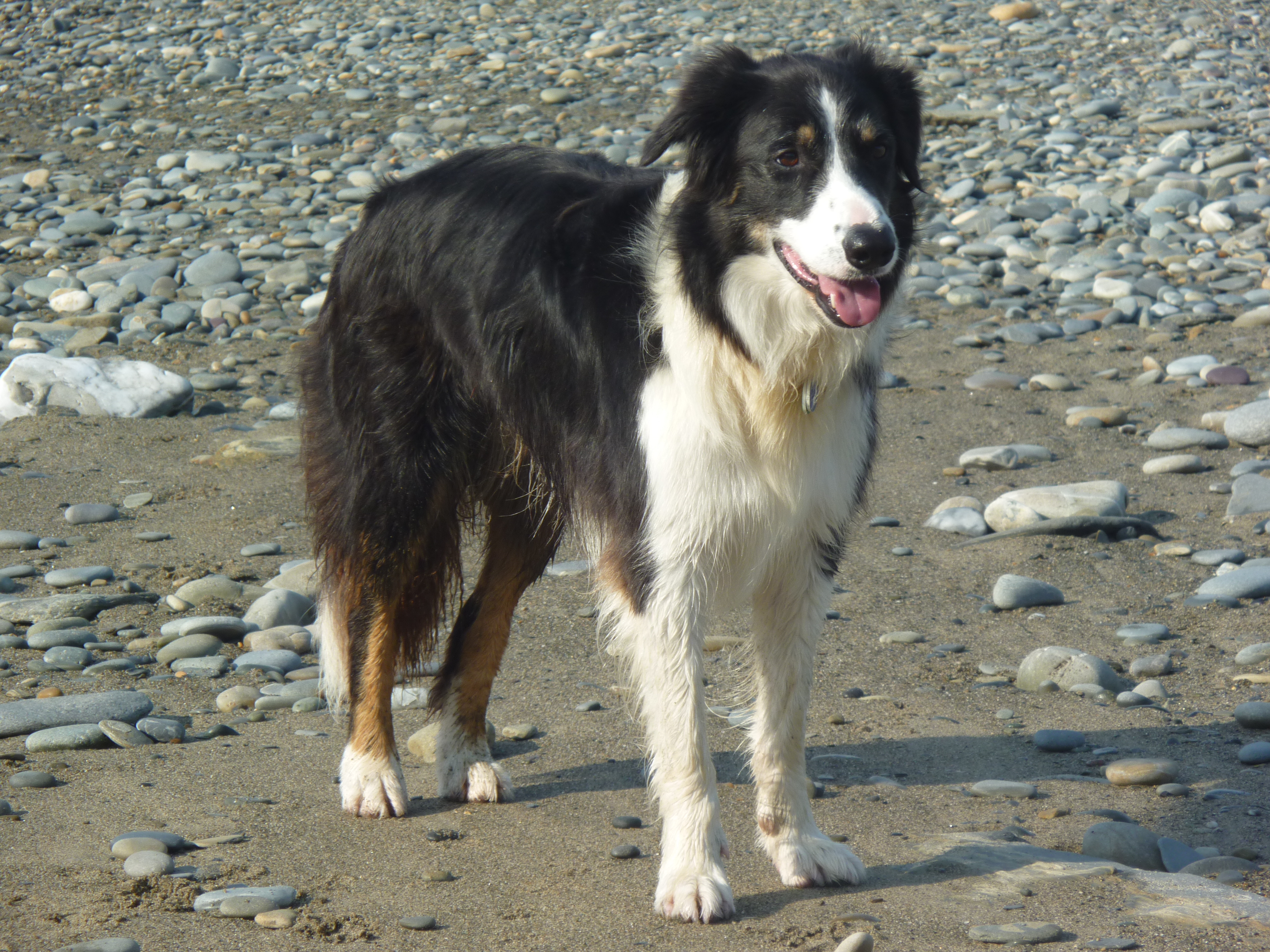
P1020007This week the problem occurred to me in relation to dogs. There I was on Abermawr beach when up came Storm. Storm is a black and white collie. His owner lives about half-an-hour’s walk from the beach. But Storm is always on the beach. For ten years or more, I’ve seen him whenever I go there. One day, I even spotted him from high on the coast path quite a distance away. A black and white dog? Yes, it was Storm.

Storm wears two tags on his collar. One says his name. The other says, ‘Please leave me on Abermawr beach.’ He loves that beach. He walks up and down it and in and out of the sea as if he just has to let you know what a fine place it is. This week, though, he looked less energetic. We could see he’s getting old. If and when he’s not on that beach, it won’t ever feel quite the same.

Storm started me thinking I’d like to write about him. And that led to me wondering if I know any folktale-type stories about a dog. No, I thought, I do not have n a single one. Then it dawned on me. I do. There’s a dog in a story I’ll be telling next week as part of Enchanted Evening, the evening of songs and stories my husband and I will be doing at Pepper’s in Fishguard with David Pepper as Paul’s accompanist.

Lifting the Sky is the story. It’s one that means a lot to me. (more…)

Storytelling Starters ~ Other worlds – Part One

Saturday, May 21st, 2016

Stories reappear in all kinds of different forms in all kinds of different places. A couple of weeks ago when I raised this theme before, an appreciative comment came through. It’s a recognisable theme with infinite potential. As memories are sparked, one story can end up as a chain of tales. So I wonder if the story I’ve got for you this week will produce some parallels. It popped into my mind while I was mentally sifting through Pembrokeshire tales ready for my session at Waterstone’s bookshop in Piccadilly next Thursday, 26 May. (Details of the event are at the top of my website. Do come along.)

The story:

P1070228A fisherman was out at sea. It was a lovely sunny day and he thought he’d take a rest. So he dropped his anchor over the side of his boat. A minute later, he was very surprised when he heard a cross voice shouting at him. When he looked over the side of his boat, he saw a little man climbing up his anchor rope. The little man looked extremely angry and he kept on shouting loudly. ‘You’ve dropped your anchor onto my house and it’s come through my sitting room ceiling.’

The magic:

So that’s the story. My father used to tell it to when I was a small child. To be honest, he kept on telling it to me every now and again until he died, aged 92. Sometimes he’d elaborate a tiny bit, describing how the little man shook his fist at the fisherman when he got to the top of the rope. Sometimes the fisherman may even have said, ‘I’m sorry. ’ But that’s all. The tale remained short.

So why did I love the story so much? Why do I love it still? (more…)

Storytelling Starters: Birdland

Saturday, May 14th, 2016

NZbirdcompressI’m visiting booming bittern territory this weekend. Will I get to hear one? If I’m lucky. The booming bittern has been one of the most threatened bird species in the UK. Evidently, it’s now making a bit of a comeback. It belongs in the heron family, lurks in reed beds and is extremely secretive. It’s the male that makes the extraordinary noise. When I heard one in the same area a few years ago, it really did BOOM.

And then there’s the blackbirds. So intense and tuneful is their singing, morning and evening, here in our part of South London, it fills the air around us. It is pure joy. 

But  for this week’s blog, I promised a story about how birds came to live in trees. This story was originally told to me by a woman from Thailand in an Adult Education class in storytelling I was running at the time.  Apologising profusely for her poor English, she then told the story to great effect. I’ve retold it in this blog once before, back in 2011. It bears repeating. I think it works well with Primary-age children.

TWO BIRDS IN A BEARD or HOW BIRDS GOT TO LIVE IN TREES: (more…)

Storytelling Starters ~ Touching base

Saturday, May 7th, 2016

Good news. David is back in Tregaron. Tregaron is a town in West Wales and David is the cuckoo I sponsor, one of the clutch that are being tracked by the BTO (the British Trust for Ornithology). It’s  reassuring that my cuckoo is not only back but busy. Sadly another tracked cuckoo, Vigilamus, also managed to make the 4,500 mile journey back to his previous breeding ground, in his case in Yorkshire, but then almost immediately succumbed to the near-Arctic conditions in that part of the country last week. 

Back to base:P1070361

In getting back to Tregaron this year, David has successfully completed his fourth migration cycle. I think of this with a sense of wonder. It’s one of those stories of nature that are really worth telling: they force you to stop and think about their many implications.

For David will not remain in the UK for long. If all goes well, he will already be back in Africa by the start of August or soon after. There, if he does what he usually does, he’ll spend the winter in the tropical forests of the Democratic Republic of Congo. Then, next January, he will set out – and cuckoos always fly alone – on his migration back north. It’s a very, very long way, taking him north into West Africa, then across the Sahara desert and over the Mediterranean before heading back through Spain and France to arrive back once more in the UK.

Where is home? (more…)

Storytelling Starters ~ Tree-thoughts

Saturday, April 23rd, 2016

15Tree barkSit under a tree awhile and listen and I bet you’ll hear it speaking to you in the rustle of its leaves and branches. OK, it’s not speaking in any tongue of  humankind. But in its own way, it’s speaking, perhaps of the wind or the seasons, perhaps of its place in the landscape, rural or urban, perhaps of the scenes it has witnessed over the length of the time it has been there. Walk past a long line of trees, it’s the same, though now you’re listening to what I hear as the trees’ conversations  with each other. Each time you go past, you can tune in. Their talk will be there – except, of course, when the trees are gone.

Ariel’s story in The Tempest:

This week, two experiences made me think about the way we humanise trees – or perhaps I should say the way they humanise us. One occurred in a fabulous performance of Shakespeare’s late play, The Tempest, at the Sam Wanamaker playhouse at the Globe Theatre. Pippa Nixon was superb as Ariel, making her feel like pure spirit brought into human form. When Prospero, the magician and manipulator who conjures all the events of the play into reality as if from thin air, reminded her of the plight she’d been in when he first came to the island, it created a horrifyingly poignant image that made immediate sense of her demand that he now set her free from having to serve him and do his bidding. When first on the island, Prospero told Ariel, he’d found her imprisoned in a tree. The evil witch Sycorax had trapped her in it, a cloven pine, and because the witch subsequently died, Ariel had had to remain trapped there and groaning for a whole dozen years before Prospero  released her and made her into his servant. (more…)

Storytelling Starters ~ Eggs

Saturday, April 16th, 2016

Cracking eggs into the mix for a fruit-cake yesterday morning, my thoughts turned to the current situation of a young friend. Suddenly I found myself thinking: ‘Don’t put all your eggs in one basket.’ So appropriate did the old saying seem to the circumstances I was considering that, as I added the flour to the mix, I began to remind myself of the story behind the adage.

Bunny and hornDon’t put all your eggs in one basket:

On a lovely Spring day, a lovely young country girl is tripping down the lane towards her local town, a basket full of eggs on her arm. And as she goes she is thinking. When she’s sold the eggs at the market – and she’s bound to sell them for they’re lovely fresh eggs – she’ll have enough money to spend, just enough, to buy a pretty new ribbon for her hair.

And when that pretty new ribbon is in her hair, she dreams,  she’s sure it will please the boy that she fancies. The boy likes her already, she’s quite sure of that, but when her hair is bedecked with that pretty new ribbon, she’s sure he’ll like her even more. In fact, he’s bound to ask her out for a walk and, when he does, he’ll surely want to see her again and before long, she’s  certain, he’ll be asking her to marry him. She knows she’ll say yes and she also knows that when they’re married, they’ll make a cosy home and have lots of children.

But it’s just here in her thoughts that this young girl trips. Oh no! It’s that tree-root sticking up out of the path that does it. Her basket goes flying, the eggs go flying and after she’s picked herself up, she is horrified to see that every one of the eggs is broken. So that’s it: no market, no sales, no ribbon, no lover, no marriage, no children.

Another view: (more…)