Mary Medlicott, Storyteller and Author - Storyworks

Archive for the ‘Personal experience’ Category

Storytelling Starters ~ Dark reflections

Saturday, August 24th, 2013

For me, as surely for others, it was a shocking moment. We were at the Radio 6 Late-Night Prom in the Royal Albert Hall. What was on offer was the characteristic Radio 6 mix of classical and pop music.

One of the performers was Cerys Matthews (who, like me, happens to hail from North Pembs). She came out on stage in trouser suit and fedora and began with some Tudor songs she said she’d dug out of original Tudor music albums. The second song was a lively jig and the words she sang to it were Welsh. I don’t know where those words originated: they sounded like a traditional folk-song, or maybe Cerys had made them up. In any case, they really suited the music and, judging from the applause, the item went down well with the audience. But in the lull before Cerys’ next song, a great rendition of Blueberry Hill, a voice shouted down from the top balcony and what it said was: ‘Your language is dead.’

Why? Why would anyone want to say that? Can anyone feel so challenged by another language, another culture, another people, that he or she would want to see it dead? (more…)

Storytelling Starters ~ Stone

Saturday, August 17th, 2013

A surprise contribution to this blog arrived this week from Jean Edmiston, my friend and long-term colleague as a storyteller. Jean lives and works in her native Scotland these days so I don’t get to see much of her.

But we often speak on the phone about stories, storytelling and our common approach, which is to believe in how stories can empower imagination for everyone if they are approached in a sharing way. Below is what Jean wrote.

The bag of pebbles (more…)

Storytelling Starters ~ Little worlds

Saturday, August 10th, 2013

You often come across them on beaches: little worlds that have been lovingly made and left to their subsequent fate by their creators. These little worlds may be excavated pools surrounded by sand-castles and carefully decorated with shells, pebbles and feathers.

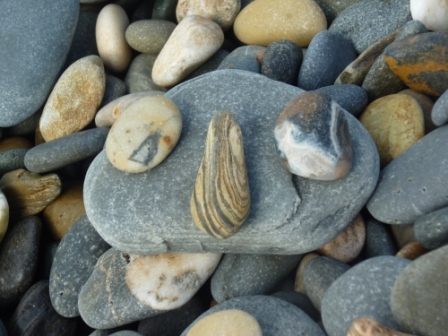
Or they may be Stonehenge-type arrangements of rocks. Or maybe, amazingly, lifelike figures created from an arrangement of stones.

I remember making such things as a child.

Fairy pools

So it was a great delight this week to come across a little world in the very process of being created down at Pwll Strodyr, our favourite tiny Pembrokeshire cove. Hardly anyone goes to Pwll Strodyr, which is one of the reasons we love it.

This week, on a beautifully warm early evening, a man and a woman and their young daughter were there. ‘We’re making fairy pools,’ said the man when we greeted him as we arrived. ‘That’s nice,’ I replied. ‘It means you could get some fairies visiting and they’ll probably bring some luck.’

When I went swimming a little while later, I was careful to collect some long strands of green seaweed which I offered to the little girl as mermaid’s hair. (more…)

Storytelling Starters ~ August days

Saturday, August 3rd, 2013

August days are times to relax, take your shoes off, go for a swim. They’re also times off for your mind, opportunities to notice things in a different kind of way, mull them over and allow the seeds of a story to sprout in your mind.

Years ago, Paul and I went on holiday to the isles of Mull and Iona. We were intrigued, on Mull, by the number of mail-boxes we passed. Again and again there they were on the road-side at the turn-off to farms and houses. Contraptions where the postman could leave people’s post, they came in different colours, shapes and sizes. Many looked like little houses. We couldn’t help noticing and commenting on them. In a flash, Mr Beaton existed.

The mail-box story (more…)

Storytelling Starters~ Summer Holiday Games

Saturday, July 27th, 2013

It’s the summer holidays – just the right time for some storytelling games. On your own, you can deliberately set out to develop all kinds of alternative scenarios to situations in traditional stories or that are happening in your own lifstorytelling games are fun in pairs or in groups.

Storytelling games develop imagination, relish quirky ideas, treasure inventiveness of language. They’re most fun in pairs or in groups.

This week I came across an excellently ridiculous story that came out of a session I ran way back in 2001. The session was with one of my friend Debbie Guneratne’s Small Tales Storytelling Clubs. I found my note of what happened while sorting through my shelves of old diaries, storytelling journals and books of stories I’ve written. The aim of my sorting was to be throwing stuff away. I can’t say I did much chucking. But I loved the reading and reflecting, particularly in regard to my journals.

The date was Saturday, 17th March 2001. First we played my Empty World game in which, as the game goes on (there’s lots of rhythm and repetition), each participant chooses an item whose name begins with the same first letter as their own first name. Afterwards, I had the idea of suggesting that we try to make links between the items that had been put into our Empty World. On this occasion, these were as follows: (more…)

Storytelling Starters ~ Compassion

Saturday, July 20th, 2013

On Thursday morning this week, I went into my study to fetch my copy of Anam Cara. This is a book by the Irish poet and scholar, John O’Donohue, and it’s all about love and compassion. Anam Cara means soul friend in Gaelic. The book talks about how we need to discover this soul friend in ourselves as well as in the friends that we make.

The Celtic Christianity in which Anam Cara is steeped is something I find deeply attractive. Its approach and ideas are very important to me even though I am no longer a practising Christian, more a kind of Christian atheist. On Thursday, feeling especially aware of life’s difficulties and with four close people in our lives having died within the last three weeks, I felt very much in need of the gentle calm and compassion that Anam Cara offers.

Afterwards, starting to think about my Blog for this week, it occurred to me strongly that it’s for the very same reason that I believe that storytelling is utterly vital, especially for children. It gives that same sense of calm, that same sense of compassionate understanding.

This week, I also started reading a quite extraordinary novel. A Man Was Going Down the Road was written by the Georgian writer, Otar Chiladze. (more…)

Storytelling Starters ~ Snoo Wilson

Saturday, July 6th, 2013

Sometimes things happen that stop you in their tracks and make you realise what is important. This week, we were devastated to hear news of the death of Snoo Wilson, husband of our close friend Ann McFerran and himself a very good friend.

We celebrate Snoo for his ordinary daily life as much as for his extraordinary work as a playwright. We celebrate him for his family and friendships and his love of his garden and his bees. He made excellent marmalades and chutney and was generally a wonderful cook. He had a fantastic sense of humour. He was erudite and thoughtful and not always easy. But the more we knew him, the more we valued him and the more we looked forward to seeing him.

We mourn him deeply even as we celebrate his life.

(more…)

Storytelling Starters ~ Pattern is key

Saturday, June 29th, 2013

Pattern is everywhere.

We see it in people’s behaviour where, over time, it can be a sign of problems and sometimes, sadly, we discern it too late.

We see it in natural life where often it’s a thing of great beauty as in the seed-pod of a poppy which provides my photo today.

We see it in the weather – and what strange weather we’ve been having this year. We must surely see it as an indication of the great upsets in the world’s climate which are being caused by global warming.

We see it in the life of birds, for instance in the cuckoo’s annual migrations which I regularly learn about in the Cuckoo Blog which the British Trust for Ornithology sends out to cuckoo-sponsors. (more…)

Storytelling Starters ~ Fire and wind

Saturday, June 22nd, 2013

My Blog-break was in Italy. And very lovely it was too. Evenings, we lit candles in the Umbrian villa we’d rented with our group of friends. The first couple of days, there were dramatic rain storms and a lot of wind. The rest of the time, the weather was hot and getting hotter. Lovely. And there were stunning views, a garden full of flowers including my favourite Love In The Mist, and when we went visiting hill-top towns, there were intriguing sights to photograph. Plus gorgeous food.

Every now and then while away, especially in the evenings when we lit those candles, I thought about the little riddle I’d included in my last Blog.

The riddle:

How can you get fire wrapped in paper?

The answer:

The answer is obvious when you know it and most obviously satisfying when you see it made real, brought out in the form of an object. For the answer is a paper lantern. The candle inside is the fire. The paper around it makes the lantern.

The story:

So clever, so simple, the riddle plays a key part in a Chinese folk-tale I was told just before I went off to Italy. The teller was Nada, one of the excellent people on my Kensington Palace parents’ workshop. She’d found the tale in a picture-book version and had recognised it at once as a good story to tell. Besides, she’d taken the trouble not only to remember the story but to equip herself with a good-looking bag for the props that she’d prepared.

Out of this bag, at the appropriate moment, came a lovely Chinese lantern. And shortly after – for as you’ll see, a second riddle is also contained in the story – she brought out her second prop. This was equally simple, equally magical.

Read on and you’ll see what it was. (more…)

Storytelling Starters ~ Feast

Saturday, May 11th, 2013

Storytelling Cookbook was the title I gave the first little book I put together with stories for children and hints on telling them. No doubt the name came to mind because I can’t help thinking of cooking and eating in connection with storytelling. Listening to stories or people talking about them just feels like participating in a feast. A traditional Scandinavian tale-ender gives the idea another twist:

 ‘And all I know is, that if they are not yet done feasting, then they are probably at it still.’

In other words, when a story ends well, it’s not hard to imagine the characters in it sitting long into the night , chewing things over in more ways than one. When I’m finishing a story with children, I often bring in that idea of eating afterwards – it’s a little bit of a tease.

A tale from India

For instance, in that marvellous Indian tale, Bhambhutia,  (you can find it in The Singing Sack by Helen East), an old lady is threatened with being devoured on her way through the forest to visit her daughter.

The story describes how she succeeds in getting back home inside a life-size clay pot she constructs. But the old lady is clever enough to stay in the pot till the animals who still want to eat her have gone to sleep and are snoring around her. It’s when she hears their snores that the old lady knows it’s safe to climb out and quickly run into her house. But that’s not quite the end of the story. Next morning, she gives the pot its reward for bringing her safely home. Either it can go round the world or it can stay with her.

It’s a good point for a bit of discussion. In my experience, lots of children say they’d choose to go round the world – and in multi-ethnic Britain, many say they’d visit the countries where their families originated. Equally, lots of children decide that, if they were the pot, they’d stay at home with the old lady. We talk about it. Then I end the discussion like this: ‘Well, in the story, it says the pot decided to stay with the old lady. And I know that’s what it did because the last time I went to have tea with her, it was still there.’

The proof of the pudding – Kensington Palace revisited

The proof of the storytelling pudding lies in the eating. Thursday was the 6th session of my Kensington Palace storytelling course for parents. It was intended as an opportunity to reflect on what has happened up till now and what might happen after this. The parents’ reports provided a feast. (more…)