Mary Medlicott, Storyteller and Author - Storyworks

Archive for the ‘Personal experience’ Category

Storytelling Starters ~ Mirror, mirror

Saturday, November 16th, 2013

Stories can be like symbols. They can tell you a lot about something you’re feeling, something that’s happened in your life. But they don’t do it directly. The information comes through the story. It comes in sideways. So if you look into the ways you’re affected by a particular story, it can sometimes let you understand and accept something about yourself.

Something like this happened to me last Saturday. The event in itself was absolutely horrid. But when I realised the symbolism in my own true story, I felt much better. It even made me laugh.

The horrid event

Last Saturday afternoon I was looking forward to watching the Wales rugby game on TV – Wales vs. South Africa. (And yes, I was going to be disappointed when Wales got beaten.) Coverage would be starting at 5 p.m. I realised I had a short time beforehand to go to my local shop for one or two things that I needed. So I quickly grabbed a shopping bag from the bag behind our cellar door in which we keep our shopping bags. The one I brought out was an old black plastic bag. I recognised it as one that had been around for some time and it wasn’t one I especially liked. But never mind, I thought. We believe in re-using shopping bags and this one would do. So I quickly shoved my wallet and shopping list inside and set off. It was starting to drizzle. I walked fast. In double quick time I got to the shops, chose some bananas from the stall outside the newspaper shop and looked in the shopping bag to get out my wallet.

My wallet wasn’t there! Nor was the shopping list.

No wallet?

And that’s when I saw the great big hole in the bottom of the bag. Frayed and gaping, it looked like someone had cut at the bag with a pair of shears. No wonder there was no wallet inside. My heart dropped like a stone. Immediately I put down the bananas and turned for home, walking as quickly as I could, hoping against hope that I’d see my wallet on the pavement or that maybe, I’d find it at home. Perhaps it had fallen out of the bag before I’d even left the house.

No wallet. Not on the street, not by my front door, not inside the house. I immediately decided to retrace my steps to the shops in case I had missed it. So I did, all the while looking carefully around, wondering about who might have picked it up and whether they might have thrown the wallet away after they’d taken everything out. No wallet. Even as I went, I was becoming aware of several feelings. They all seemed to dawn on me at once. First I felt extremely stupid. Why hadn’t I looked in the bag? Why had I not noticed the hole?

Secondly, it dawned on me that I now had no money and no credit cards. Paul was away for the day. There was no spare money in the house. So I wouldn’t be able to buy what I needed. This made me suddenly realise what it must be like to be often or always in such a situation. It made me identify deeply with people who – especially in the present financial situation – often or always have that same feeling of powerlessness and need. I at least have a husband who’d be arriving home later and who’d be able to get what was required. Also, I do have friends in my street who’d have helped at once if I’d gone to ask.

Meantime, even as I continued to feel very stupid, I was already extremely anxious about the credit cards that had now gone missing with the wallet. I was aware I’d have to try and cancel them as soon as possible. So I’d have to remember what they were, I’d have to find the telephone numbers to ring and I’d have to get on with it quickly. For I still wanted to watch that rugby match. I had one hour to do the job. Amazingly, I managed it. Then I sat down to watch the rugby match, feeling stupid, downhearted and shaken.

Is this me?

Later when the game was over, I looked again at that shopping bag. It was obviously a well-worn bag. It would not have been surprising really if there’d been a tear in the bottom and quite understandable if that tear had got bigger as the bag swung around with my wallet inside.

And then it dawned on me why I was feeling so bad. Because of what had happened, I was feeling like the bag itself – unobservant, broken, frayed, unsafe. As soon as I realised the symbolism, the connection between the story of what had happened and myself, I felt better. I may be sometimes unobservant and inattentive (isn’t everyone?). I’ve been around for a bit. I’m getting a bit frayed round the edges. And, coincidentally, I use the name Old Bag Productions when I make greetings cards for my family and friends. But that, I hope, is where the comparison can stop. So now I can laugh about the symbolism in my own story.

P.S.

As you can see, my photos this week are of bags. In the circumstances, the theme is irresistible. But these bags are my good, true and infinitely-well-used story-bags, the ones I have used so many times to carry about the beautiful cloths, musical instruments and other fascinating items that I employ in my storytelling. (more…)

Storytelling Starters ~ Through the Post

Saturday, November 9th, 2013

The post this week brought unexpected things. First arrived a large envelope from Sweden. This contained four smart-looking booklets – the published list of all nominees for the Astrid Lindgren Memorial Award 2014. There are 238 of us from 68 countries. Out of the total – I’ve checked! – only 12 are listed as oral storytellers. Some of the 12 are also described as authors and, in a couple of instances, as reading promoters too. We come from countries as diverse as the British Virgin Islands, Malta, Malaysia and the UK.

The nominees

It’s as exhilarating as it is daunting. The UK nominees for the Astrid Lindgren Award could hardly be a more prestigious bunch. Allan Ahlberg, Quentin Blake, Kevin Crossley-Holland, Michael Foreman, Shirley Hughes, Michael Morpurgo, Jill Paton-Walsh, Terry Pratchett, Michael Rosen, Meg Rosoff. Yet how wonderful it is that it’s possible for oral storytellers to get included alongside such extremely distinguished authors and illustrators. There are two of us in the UK list – Liz Weir who comes from Northern Ireland and myself who comes from Wales. Interestingly, both of us have worked across divides. Liz in Northern Ireland is especially well-known for her work across religious divides. In Wales the divides are perhaps less obvious. Yet, linguistic and cultural, they are both present and very pertinent. (more…)

Storytelling Starters ~ Hail Mighty Sea

Saturday, November 2nd, 2013

What objects can be used to introduce and accompany storytelling? The question arrived in my Inbox this week in an email from a woman from Brazil who has newly come across storytelling and fallen in love with it. She already uses her guitar. But what else might she  employ? She’d found my website on the net and wanted to know of any books that could help.

The Magic of Objects was the theme of a series in this Blog on each Saturday of October 2011. Look them up, it’s a theme that’s close to my heart. My sea-tray … fans … colour cloths … magic music … such objects have given me enormous use in such wide-ranging circumstances. They have also observeably brought enormous pleasure to audiences of adults and children. In this week of wind and storms I have thought in particular about my sea-tray.

Hail Mighty Sea

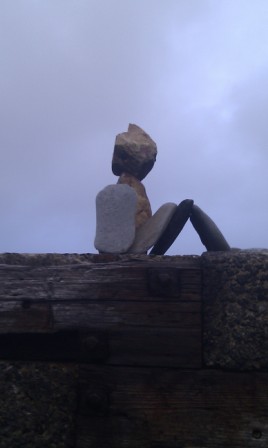
I was first reminded of my sea-tray at the start of the week. Down on the sea-wall at Abereiddi beach, one of our Pembrokeshire favourites, words written out in pebbles declaimed the stirring message: Hail Mighty Sea.

On Abermawr beach the following day, a young boy on the pebbles was looking out to sea, arm raised in a great gesture of greeting as the incoming waves swirled over his Wellington boots. When I passed him soon after as he left the beach with his sister who’d done the same after him, they and their father looked completely delighted. The children were sopping wet but they’d had a unique experience(quite safely I might add). They’d hailed the sea in all its grandeur.

Both incidents in turn put me in mind of the Birmingham children who came on an exchange visit to the Cardiganshire coast in the art and storytelling project, On The Train, that was organised a few years ago now by artist Catrin Webster. The visiting children had whooped with delight when they caught their first sight of the sea (most of them had never seen it before) and had run pell-mell towards it and, in the case of some of them, right into it.

The sea is a fundamental experience. We should all be able to have that experience if we possibly can. If only! In the Guardian recently, George Monbiot, whose book Feral came out earlier this year, strongly urged the point that a week in the country is worth three months in the classroom. In his Guardian article he recommended that every class in every urban school should regularly be taken to spend time in the country. If only! The idea, alas, feels as unachievable in our present world as my profound wish that every class should hear (and be able to talk about) a told story once a week at the very least in every week of their school year.

Impossible? At least through stories we could give all children, older and younger, an experience of discovery and a sense of magic and awe.

The sea-tray

That’s where my sea-tray comes in. It produces the best sea-sound I’ve ever heard away from the sea itself. It can either introduce a storytelling session or a particular story. Or it can be employed in the course of a story. Use it and you take people on a real journey of the senses and the imagination.

Practical reminder:

My own sea-tray comes from a junk shop in New Zealand. It possibly originated in the South Sea Islands as a device for carrying fruit. I know similar trays are found across Asia and Africa where they are generally used for sifting rice or lentils.

To provide yourself with your own sea-tray, seek out a smooth or rough round wooden tray or perhaps a bodhran which is a type of wide Irish drum. Empty onto it a bagful of very small stones you’ve specially collected for the purpose or alternatively a bagful of beans. Swish these round in a rhythmic way, imitating the rhythms and pauses in the sound of the waves and – hey presto! – you could at once feel you were standing on the shore. Just like that delighted boy this week! (more…)

Storytelling Starters ~ Awarded

Saturday, October 19th, 2013

It was a wet and windy night. Yet in Milton Keynes last Saturday, October 12th, inside the Creed Street Arts Centre in Wolverton, the welcome was warm and hospitable. We were there for the award-giving Ceremony for this year’s BASE awards.

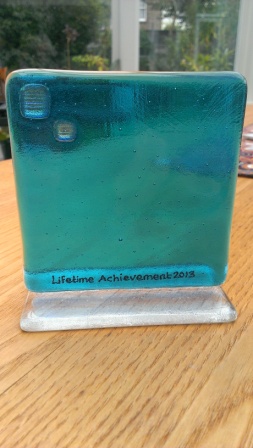
Lots of people had come. Shonaleigh and Peter Chand hosted. A great Spoken Words Artist, Richard Frost, acted as compere for the evening. Stories were told, awards were given, acceptance speeches made. Last up, I was made the delighted recipient of this year’s Lifetime Achievement Award. As on every day since by the emails and phone calls that have followed, I felt extremely touched and honoured.

What I’m most pleased and proud about is that the Award feels like a recognition of the particular approach to storytelling that has been mine now for 30-odd years. It’s an approach I share with many others and it forms the basis of this weekly blog. I describe it as a sharing approach where, whatever the kind of storytelling occasion, be it a performance to adults or a session with Under-5s, the storyteller is in one way or another reaching out to others and in so doing acknowledging the truth that we all have stories inside us. Some stories we may not like to hear. Some may need help to be told. Some will be well told, some very badly. Some can be acknowledged only in the listening. But no single storyteller has all the stories or all the ways of telling them. Stories are our common wealth and I love and treasure the telling, the listening and the sharing.

P.S. Lots of people have asked what I got. My photo displays the answer. I hope it gives you an idea of the loveliness of the blue. (more…)

Storytelling Starters ~ BASE Awards

Saturday, October 12th, 2013

This evening I’m off to the BASE Awards event in Wolverton. And if you don’t know where Wolverton is, it’s right next to Milton Keynes.

Ancient Egypt and Us

Milton Keynes is a resonant place-name for me. I once worked with a brilliant class of 10-year olds there. One of the topics in their class at the time was Ancient Egyptians. The other was Ourselves. Their teacher wanted a project to bring the two topics together.

Of course, it’s possible to tell stories from Ancient Egypt. I did – and the children loved them. But how is it possible to imagine the length of time that has passed since the Ancient Egyptians existed? These children certainly couldn’t. Like most children of their age, they had little sense at all of time passing. So I came up with the idea of a Memory Chart on which each child would use hieroglyphs of their own design to notate one memory for each year of their lives so far. We made an exception for their first four years: most people have few recollections from that period. So those years, we decided, could be lumped together and occupy just one box in each person’s chart.

Memory work

The children were brilliant. When we did the initial memory work, there was a lot of jotting down, telling and retelling of what had happened. Then came the making of the memory charts. Each person creating their own, the hieroglyphs designed by the children were fun and inventive. Last came the bit of the project when, working in small-ish groups, the children worked out clever creative ways to tell their small stories as a group. One group, I recall, created a fascinating audio-spiral of their stories where each different year in their memories was signalled by the sound of a gong.

Milton Keynes again

So Milton Keynes it will be tonight. The BASE awards organisers have worked very hard. I hope their Awards event proves a lovely, sociable success. What’s more, I hope it helps to promote and encourage all aspects of the art of storytelling. (more…)

Storytelling Starters ~ Subversives wanted

Saturday, October 5th, 2013

Monsters make an excellent theme for developing children’s creativity. Monsters appeal to young people – there’s something essentially subversive in both.

So whether you’re a parent, teacher or children’s club leader – and whatever the age of the children you work with – you can get a lot out of monsters.

Here’s a programme for pursuing a Monsters theme:

• Find one or two good monster stories – for instance the Greek story of Typhon with older children 

• Prepare the stories for telling, then tell them to your children, be they in class, at home or in some kind of children’s club

• Allow time for the children to come up with comments and questions (in class or clubs, working in pairs or groups is best)

• Ask the children to suggest some modern-day monsters – you might be impressed by their ideas – and make a list of the monsters

• Invite them to draw, paint or make models of the monsters they’ve thought of (this gives them useful thinking time)

• Give them the time to make up a story about their particular monster (working in groups is best in a class)

• Get them to tell their story (each group can tell in turn to the others)

Fantastic!

This whole enterprise could take a full morning or evening session or be spread out over several sessions. (more…)

Storytelling Starters ~ Travels

Saturday, September 21st, 2013

Between 4 and 5 p.m. on Saturday 5th October, I’ll be giving a performance at the London Welsh Centre. My session is part of the London Welsh Literature Festival, three days of Welsh culture with poetry, fiction, music, drama and talks as well as my storytelling.

My preparations have made me think about what revisiting a sequence of stories involves. Do come along! See booking details below.

Travels With My Welsh Aunt

Travels With My Welsh Aunt was the first whole-evening, one-woman show that I did. Actually, it wasn’t quite a one-woman show: the storytelling all came from me, but there were points where singing welled up from the audience from some of my fellow-members of the London Welsh Chorale, the choir in which I sing. Of course, this had been prepared. I’d asked them if they’d be willing to participate and their apparently spontaneous joining-in with some hymns and songs added greatly to the evening’s atmosphere. It added too to my theme. For my Aunty Mali, on whom Travels With My Welsh Aunt is based, was a notable music teacher also well known for her conducting of hymn-singing Cymanfa Ganu festivals in Wales long before it was normal for a woman to be seen in that role.

Travels With My Welsh Aunt first got performed in full in 1999. (I’d previously done a pilot at Festival at the Edge.)

Revisiting it now on October 5th, it’s going to feel very different. For a start, it will be up in the bar at the London Welsh Centre and not in the main hall so less formal. Also, the piece will be shorter. Back in 1999, as on subsequent occasions in Village Halls and other venues , it consisted of two halves, each of about three-quarters of an hour. This time, it will last an hour.

Besides, I’ll be returning to a piece that has lived in my mind for a long time since I first brought my conception of it into being. So I’ve been thinking a lot this week about what happens when a storyteller revisits a favourite story or stories. Of course, it’s something storytellers do frequently. You have stories you love: you retell them and, in the process, you observe how much they’ve changed or stayed the same as the last time. You also become highly aware of how venues, the weather, season and different audiences affect the telling. However, specifically setting out to revisit a whole series of stories in a piece that’s especially important to you – well, maybe that involves a process all of its own. (more…)

Storytelling Starters ~ Tellable tales

Saturday, September 14th, 2013

It’s great to come across a new collection of extremely tellable tales. Girls, Goddesses and Giants by Lari Don (A & C Black) has just this week come into my hands as one of a lovely pile of books I’ve been sent to review for School Librarian magazine. Chris Brown, the magazine’s long-term Books Editor, is just about to retire from that position. He’s done a marvellous job over all of the years. I shall miss him. He always seems to know what books I will value receiving.

Girls, Goddesses & Giants addresses a continuingly important need in stories, namely for strong girl heroines. When I was growing up, I always identified with the young men who were the usual fare in the hero department. Heroines were in shorter supply. Whenever a brave prince was rescuing a kidnapped princess doomed to be sacrificed to a voracious dragon, I became the sword-wielding prince as well as the princess.

Lari Don is not only an author. She’s a practising storyteller too. She has felt the same strong need. And as she says in notes at the back of her book (these include helpful hints on adapting stories to suit your own style), she has felt compelled to satisfy it even while actually being in the middle of telling to an audience of children. The 12 stories in her collection come from all over the world. One of my favourites is a Cameroonian tale, Mbango and the Whirlpool. It brought back to my mind Philip Pullman’s point, made in the interview I quoted a week or two back, that a main reason why children love folktales and fairytales is their belief in justice. They want to see fair play being done. (more…)

Storytelling Starters ~ A Fresh Look

Saturday, September 7th, 2013

This is an excellent time of the year to take a fresh look at oral storytelling and what it has to offer. About now, Year 7s in Secondary School are usually getting going on some kind of getting-to-know-you project. Who are you? Who am I? It’s part of familiarisation, becoming acquainted and establishing new bonds in a new form and a new school. At the other end of the spectrum, very small children are taking their first steps into education. Attending Nursery School for the first time, they are hearing strange voices, learning new routines, getting used to being with lots of other children.

At this point, I urge teachers and childcare workers across the age-range to consider how told stories engage our attention whatever our age and circumstances. Told stories are when you sit up and take notice. Someone is speaking directly to you – and it’s not to give instructions or obviously to teach you new things. It’s to tell you something that might interest you as another human being.

Sources of information

Plenty of information about oral storytelling is available here on the Internet, on storytellers’ websites and on Youtube, as well as in books, on storytelling courses and in storytelling clubs and even in back numbers of this Blog. Picking up on the art and the craft of storytelling can open new doors for the teller and the hearers. (more…)

Storytelling Starters ~ Advocacy

Saturday, August 31st, 2013

With the new school year in England and Wales on the verge of beginning, it was heartening to read Philip Pullman talking about fairytales in a Guardian newspaper interview last weekend.

Grimm Tales for Young and Old comes out in paperback from Penguin Classics on 5 September. It’s Pullman’s retelling of 50 of the Brothers Grimm stories. The Guardian interview was occasioned by the forthcoming publication and the best thing about it for me was that Pullman not only encourages the reading of such stories with children – indeed, he thinks it is vital. He is a terrific advocate of telling them too.

Oral storytelling needs this kind of advocacy. The telling of stories is not a new piece of technology that would inevitably get huge publicity and become desired as the next have-to-get thing. It’s been there over all the centuries of human development. But, sad to say, its enormous and magical power is currently receiving insufficient recognition in the educational world. For anyone who employs it with children – as Pullman himself used to do when he was a Middle School teacher in Oxford – its positive effects quickly become apparent.

Children have an enormous sense of fair play and, according to Pullman, this is the central reason for the appeal of the fairytale to them. Fairytales see that justice gets done. Besides, fairytales have a direct no-nonsense approach to story: there’s never any hanging about, action and event are all-important. This, too, makes them appealing to children. But that’s not the end of the potential of the fairytale for them.

When Philip Pullman was training teachers at Westminster College, Oxford ( where in years gone by I used to give storytelling workshops) he would encourage students to ‘get a few stories into their heads well enough to tell them to a class without referring to the book.’ His Guardian interview attests to the effect on children of doing this: they attend to stories that are told and, years hence, will remember being told them. (more…)