Archive for the ‘All ages’ Category
Saturday, December 24th, 2016
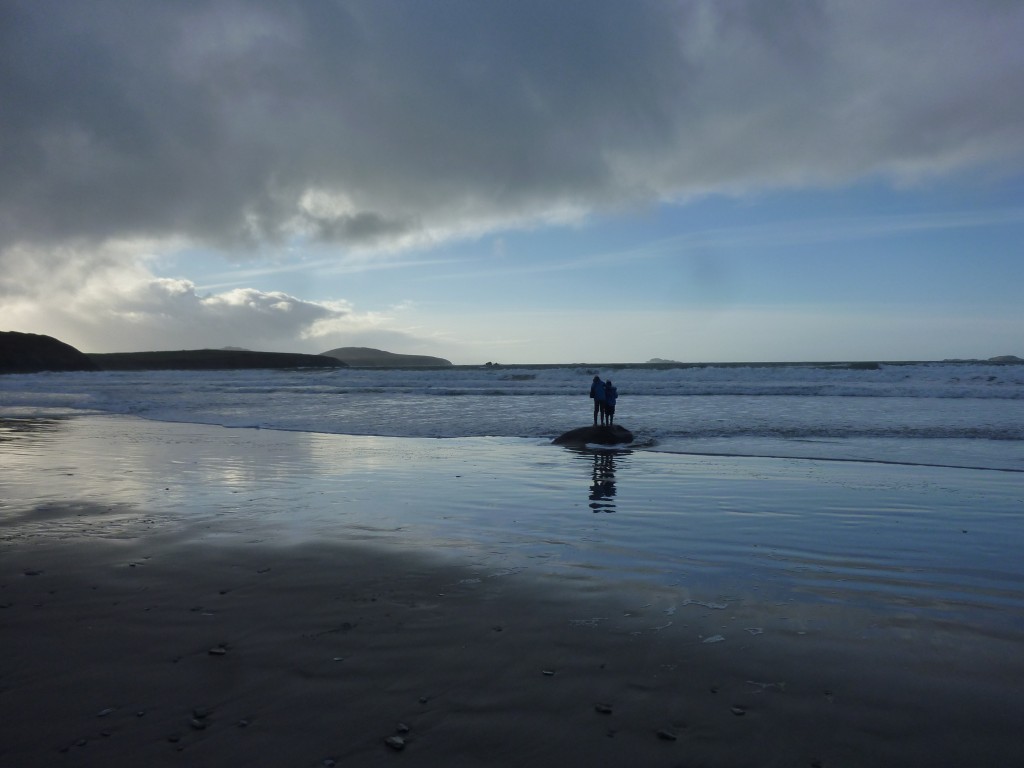
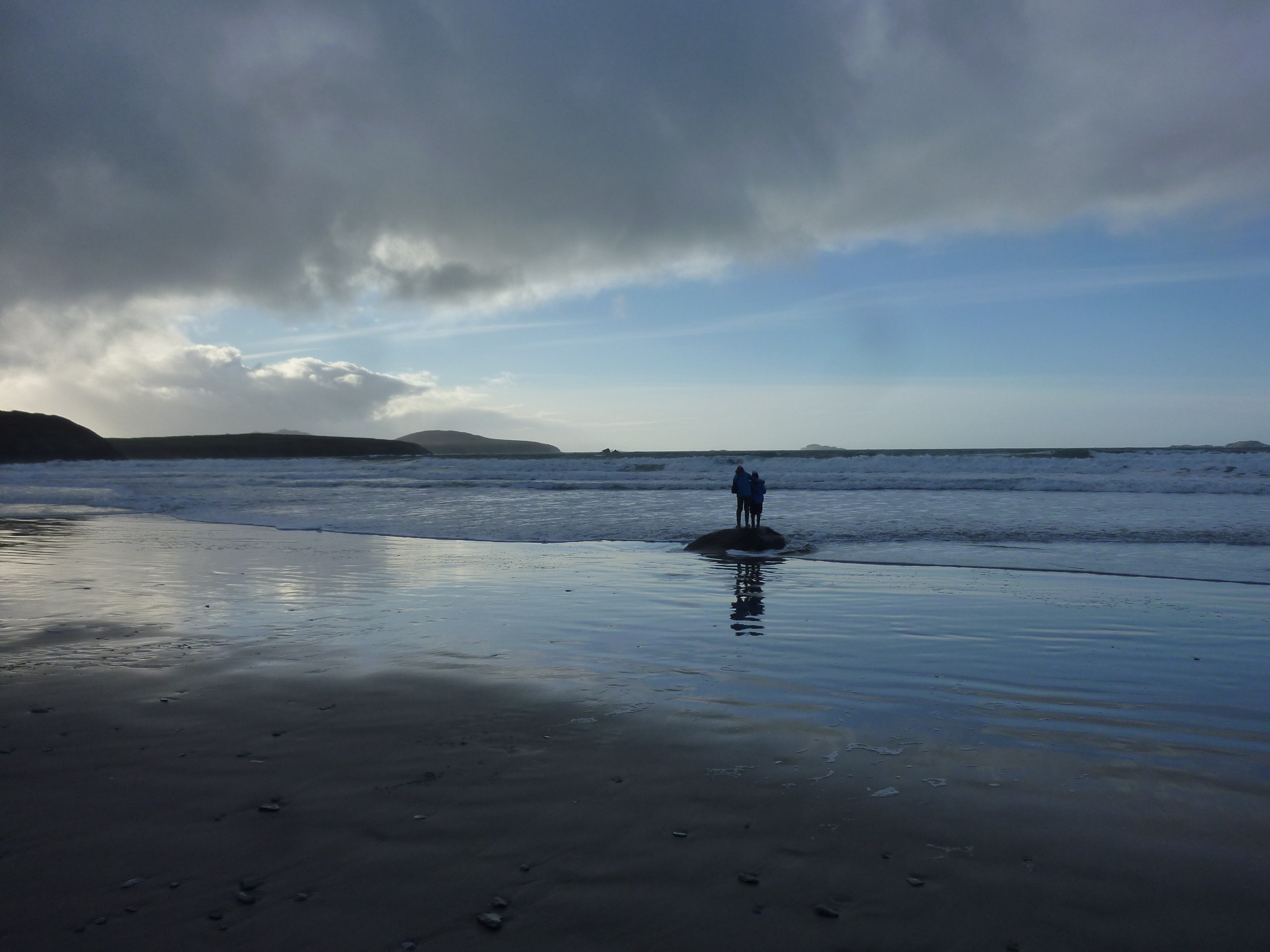
Dear friends, this is to wish you a Happy Christmas and a healthy and hopeful New Year. The photo above was taken this week on Whitesands Beach in North Pembrokeshire. The two children in it are standing on a rock which I’ve been seeing since my own childhood. Last year, a storm had scoured out so much sand from the beach that we saw how huge the rock is when you can see all of it. We saw the very bottom of it. By now, it is just that smallish hump of stone again. I like to think that Dewi Sant, the Patron Saint of Wales, must have seen this rock too. When I think about him, I like to remember that, at the end of his life, he told his friends to remember to do the little things. What he meant, I think, was to remember the kindnesses we can all do. This feels like an important message to us all amid the upheavals and horrors of our world today. I pass it on with my best wishes and love. (more…)
Tags: St David, the little things, Whitesands Beach
Posted in All ages, Christmas, Personal experience, Riddles, rhymes, sayings | 2 Comments »
Saturday, December 10th, 2016
![apple-star[1]](http://www.storyworks.org.uk/wordpress/wp-content/uploads/2013/12/apple-star1.jpg) I took a bit of a risk on Thursday evening. We were giving the second in our Enchantment series of Songs and Stories concerts at Pepper’s in Fishguard. This was Winter Enchantment. During the second half, I was going to do two readings – one from A Child’s Christmas in Wales by Dylan Thomas, the second the hilarious Twelve Thank-You Notes of Christmas, originally written by I’ve no idea who.
I took a bit of a risk on Thursday evening. We were giving the second in our Enchantment series of Songs and Stories concerts at Pepper’s in Fishguard. This was Winter Enchantment. During the second half, I was going to do two readings – one from A Child’s Christmas in Wales by Dylan Thomas, the second the hilarious Twelve Thank-You Notes of Christmas, originally written by I’ve no idea who.
But in the first half, I’d decided to tell three short stories. The third was Baboushka, the poignant story of Russia’s Mother Christmas. (Put Baboushka into the Search box on the left of this blog; you’ll come up with my posting for December 17, 2011). The second story was The Pointing Finger which I recounted here a few weeks ago on November 5, 2016. The first was the story I call Star Apple.
Star Apple was a risk because I think of it as a story for children. But this was an audience of adults. Granted, I’ve told it at this time of the year to any number of teachers’ or parents’ workshops. ‘It’s a great story to tell to children,’ I say. ‘It’s easy to remember. It has the great advantage that it needs a prop (always a help because it gives you something to focus on). Besides it is about a star – and that is very seasonal as we think about Christmas.’
Why I decided to take a risk on it at Winter Enchantment is that the story is simple and magical and I thought some of my audience might be inspired to retell it at family gatherings over Christmas. Why not be ready with a story to entertain whoever is present? (more…)
Tags: A Child's Christmas in Wales, Baboushka, Dylan Thomas, Pepper's, Star Apple, The Pointing Finger, The Twelve Thank-You Notes of Christmas, Winter Enchantment
Posted in All ages, Christmas, Folktales, Props and Resources, Repertoire, Seasonal Tales | No Comments »
Saturday, November 19th, 2016
 Thursday night, we went to see King Lear in the Royal Shakespeare Company production at the Barbican. It was hard and long and brilliant and Anthony Sher was a completely believable and utterly moving Lear. As his three daughters responded to his request to tell him how much they loved him, it was immediately clear what devastating effects would follow from what the youngest of them said.
Given the harsh immediacy of those early scenes, I suppose it was odd but also inevitable given the way the human brain works (or perhaps it’s just storytellers or maybe just me!) that, during them and later, a story I used to tell was hovering somewhere in my brain. The following morning, I looked it up.
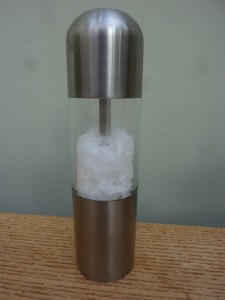
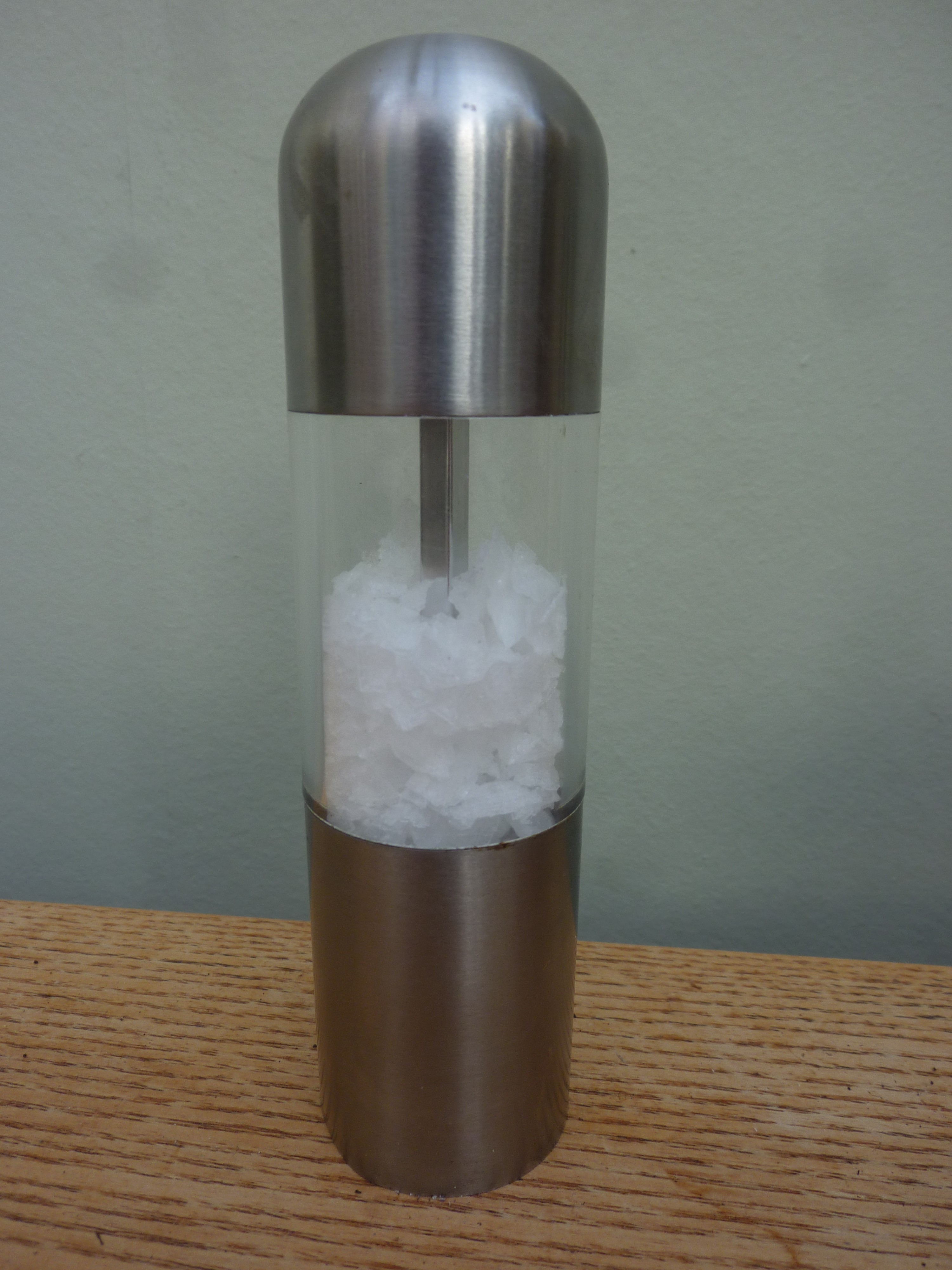
Dear as Salt is a story from Bologna. It appears in Italian Folktales, the wonderful collection made by Italo Calvino. As exhilaratingly daft as Lear is tragic, it’s a story I used sometimes to tell during the years when I was storytelling at Somerset House in London. In times long past, Somerset House was where the Salt Office was housed. So in my programmes of stories of the place itself, I usually included one or other story of salt. Hence Dear as Salt which, like King Lear, also begins with a king asking his three daughters to tell him how much they love him. In the Shakespeare play, the results are devastating. And in Dear as Salt? Well let me briefly tell you the story.
Dear as Salt: an Italian folktale
A king challenged his daughters: ‘ You don’t love me!’ The eldest said, ‘I do. You’re as dear to me as bread.’ The middle one replied, ‘You’re as dear as wine.’ The youngest said, ‘As dear as salt.’ (more…)
Tags: Anthony Sher, Barbican, candlestick, Italian Folktales, Italo Calvino, King Lear, salt
Posted in All ages, Folktales, Personal experience | 2 Comments »
Saturday, November 12th, 2016
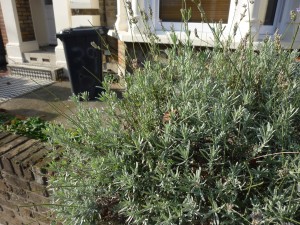 This week on an afternoon walk, I passed the two bushes in my photos. The first is lavender, the second I’m not sure of. But from each, a beautiful perfume came out. Each made me think. ‘If only I could somehow encode that perfume and send it out on my blog this week.’ Might that ever be possible? Perhaps – but I’m sure it wouldn’t be as good as the real thing.
Then I started to wonder. ‘Do I know any stories where perfume is important?’ The question made a good accompaniment to my walk as it started to rain.
Perfume from India:
First I thought about the story of Ganesh, the Hindu god. When his mother Parvati made him, her husband Shiva was away and she was lying in her bath, scraping off the soaps and creams she’d applied to her body. From the little ball she rolled them into, she began to mould a little boy. The little boy quickly became alive and immediately began to grow. By the time his father returned, the boy was guarding the door of the bath-house. Of course, his father did not know who he was and, angry at seeing an intruder claiming to be Parvati’s protector, he summarily cut off the boy’s head.
And the rest – how the boy then gained his elephant head and became the much-honoured Ganesh – is, according to your taste, a matter of religion, myth or story. There’s nothing specifically about perfume in it. But I reckon that, as Ganesh is the god that helps people with their problems, he is undoubtedly perfumed with kindness. (more…)
Tags: a wise saying, Baluchistan, dew-drops, dilemma tale, Ganesh, Hindu story, magic spell, roses
Posted in All ages, Folktales, Myth and Legend, Riddles, rhymes, sayings | No Comments »
Saturday, November 5th, 2016
A story has been haunting me, going round and round in my mind. It’s kept returning over the last few weeks and, each time I find myself thinking it over, I wonder why it is there. OK, I love the story. And I love who I heard it from, storyteller friend Debbie Guneratne. But why is this story from her in my mind now? So many questions. But first let me tell you the story.
The Pointing Finger:
 It was hot. So hot that even the air felt hot and, beneath his bare feet, the hard ground of the village square felt as if it was scorching his skin. The young man felt thirsty. He also felt worried. What was he ever going to do? His studies in the town were going well, his teachers said he was clever. But how was he going to complete his studies on so little money and with so little hope?
All these questions were turning over in the student’s mind as he sat on the bench in the village square that hot morning. Suddenly, there came the stir of voices and movement on one of the roads that came into the square. It looked like someone important arriving, surrounded by attendants and awed onlookers.
It was some kind of prince, that was obvious. His robes were richly embroidered, his hair was glossy, his beard well-tended and round his neck was a garland of flowers. The prince, if that’s what he was, swept into the square and looked around. There was very little to see – a tree that looked like it needed water, a fountain from which rose too little water to enable it to look like a fountain should.
As he walked grandly round the square, the prince suddenly stopped. His eyes, evidently, had fallen on the student who by now was walking along to the side of the prince, staring avidly at him‘What do you want?’ the prince suddenly said, stopping in his tracks as if he’d only now become aware of the student. For a moment, the student was silent, as if had no idea what to say. Then he quietly replied, ‘Anything … something … whatever you can give.’ (more…)
Tags: Debbie Guneratne, fountain, jewels, The Pointing Finger, Winter Enchantment
Posted in All ages, Folktales, Preparing, Seasonal Tales | 6 Comments »
Saturday, October 15th, 2016
 Red has been in my thoughts all week. It’s one of the colours of Autumn and, in the UK, Autumn is certainly here. There are lots of red berries in our local park (a sign, some say, of a hard winter to come). And in our garden, the Sumach tree has turned the most stunning red it’s ever been.
So red has been in my thoughts all week which is why the stories my blog offers this week are, first, a gorgeous little Irish story that was collected by Thomas Crofton Croker and, second, a tiny part from the very first page of the very first story in the great medieval cycle of Welsh tales known as the Mabinogion. The fact that red figures in both is no surprise. Red is a colour traditionally associated with the supernatural in both Welsh and Irish literature.
Red socks: a tale from Ireland
Tom was on his way home from the fields when he saw a leprechaun in a hedge. As he watched, he saw the tiny creature reach down a drink of beer from a pitcher and then return to putting a heel-piece on a tiny shoe just the right size for his foot. (more…)
Tags: ears, Lady Charlotte Guest, Red, socks, Sumach tree, Thomas Crofton Croker
Posted in All ages, Animal stories, Folktales, Myth and Legend | No Comments »
Saturday, October 8th, 2016
 Odd how things happen, isn’t it? On Thursday evening, we went to a concert at the Union Chapel in Islington. I hadn’t been there for a million years – and it’s a beautiful place with a fascinating history. Way back then, my visit was to hear the wonderful Welsh singer and harpist, Siân James (with whom I once did a storytelling performance). Now it was to hear the equally wonderful Portuguese fado singer, Claudia Aurora.
One of Claudia’s songs on Thursday was all about insects. She introduced it with a heartfelt (and very funny) account of how she cannot bear SPIDERS and how she’d found a HUGE spider on one of her curtains and was TERRIFIED until her neighbour came to the rescue.
So there I sat as she was speaking, my mind ranging over the subject of spiders – all the cobwebs currently on my windows, for it’s definitely been the spider season, and how, when someone tells me how they hate spiders, I often briefly recount that North American Indian story which is such a brilliant reminder of our human foibles. (more…)
Tags: Claudia Aurora, insects, Siân James, spider, sting, Union Chapel
Posted in All ages, Animal stories, Folktales, Personal experience, Personal Tales | 2 Comments »
Saturday, August 20th, 2016
My husband has been singing Scottish folk-songs. Two friends from New Zealand have just been on holiday to Scotland’s West Coast and loved it. Their trip included Oban, which is where one of my grandfathers came from. And yesterday talking with my Scottish storyteller friend, Jean Edmiston (she sent a lovely comment on last week’s blog), we talked a lot about the sense of place and how powerful it is when you’re storytelling.
A poem from Arisaig:
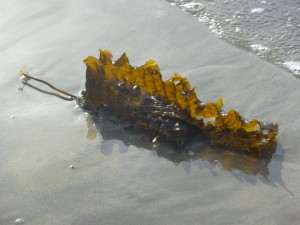 It must have been all those Scottish connections that made me remember a poem I once came across. It was hanging on the wall of a pub or café (I can’t remember which) in Arisaig one time we were up on that same West Coast. I wrote it down and afterwards I told the story of it and read it out to classes of children on a number of storytelling occasions. Once with an especially responsive class of ten-year-olds, we somehow got the idea of doing the poem with sound effects. I remember auditioning volunteers for all the many different sounds in the poem – the gulls, the whimper, the grey dog running. Then we performed it, me reading the words, them doing the sounds. They were wonderful. It still brings a thrill to my spine to recall it.
So this week, I’m quoting the poem in full because it’s one of the most haunting poems I’ve ever come across and so evocative of a sense of place. Also it affirms the truth that stories come in many forms, including in poems. But first let me expain the background to it’s story. According to a note that accompanied the poem where it hung on that wall in Arisaig, it so happened that at the time of the Highland Clearances at Rhu Arisaig – and the Highland Clearances were where crofters were cleared off the land by land-owners – one of the families that were evacuated by boat accidentally left behind a favourite collie. Afterwards, it was often said locally that, at dusk on certain evenings, the ‘grey ghost’ searches the shore.
The Grey Dog of Rhu Arisaig – by Roy Ferguson (more…)
Tags: Scotland; Rhu Arisaig; grey dog; Roy Ferguson
Posted in All ages, Animal stories, Getting participation, Poems | 8 Comments »
Saturday, August 6th, 2016
 Today, I’ll be doing something I’ve never done before – telling a story at the National Eisteddfod of Wales. Two storytellers who live in Wales, Marion Oughton and Cath Little, have invited me to join them in the storytelling session they’re giving in the Welsh Learners’ tent on the Eisteddfod field. This will be a pleasure. The National Eisteddfod is an annual event, held in a different part of Wales each year and oscillating between the north of the country and the south. This year it’s being held in Y Fenni (known in English as Abergavenny) and it’s proving extremely well-organised and highly successful. In the two days I’ve been here already, I’ve loved it.
My story: Three Sisters
The story I intend to tell – in Welsh of course – is a story about three of Wales’s best-known rivers. At the start, we meet three sisters living on top of a mountain in mid-Wales (and therefore not far from Y Fenni). They make their clothes out of birds’ feathers. They wash in the limpid pools of water left on the mountain top by the rains. When they look into the distance they can see the sea and sometimes they get a scent of it. They fantasise. What would it be like to go to the sea?
Fantasy in this story turns into a definite plan as the sisters decide that the very next day they will go and visit the sea. What will the seashore be like, the oldest sister wondered. Will the sea shine? the middle sister asked. Would they see silver fish in the waves asked the youngest.
In the morning, the eldest sister woke early and decided to go some of the way down the mountain at once to see what the journey would be like. She dressed and washed and then, putting her feet in a pool of water, drew the water behind her as she started down the mountain. But the countryside around her was so lovely, she completely forgot her plan to return for her sisters and, instead, went smoothly on. (more…)
Tags: Cath Little, Marion Oughton, National Eisteddfod of Wales, river Rheidol, Severn river, Together Stronger, Wye river
Posted in All ages, Folktales, Nature stories, Performance, Personal experience | 2 Comments »
Saturday, July 9th, 2016
![Flag-of-Wales-thumbnail[1]](http://www.storyworks.org.uk/wordpress/wp-content/uploads/2016/07/Flag-of-Wales-thumbnail1-300x240.png) OK, I admit it. Over the last few weeks, I’ve become a devoted football fan. Obviously that’s because I’m Welsh and the Wales football team did so brilliantly in the Euros. It wasn’t easy seeing them get knocked out against Portugal in their semi-final this Wednesday. Yet, especially in this post-Brexit world, it’s an inspiration that the team believes so much in the strength of playing as a team, they pay such high regard to their fans and the support they get from them, they speak with such warmth of their country and they have been so good-humoured during their time away in France.
OK, I admit it. Over the last few weeks, I’ve become a devoted football fan. Obviously that’s because I’m Welsh and the Wales football team did so brilliantly in the Euros. It wasn’t easy seeing them get knocked out against Portugal in their semi-final this Wednesday. Yet, especially in this post-Brexit world, it’s an inspiration that the team believes so much in the strength of playing as a team, they pay such high regard to their fans and the support they get from them, they speak with such warmth of their country and they have been so good-humoured during their time away in France.
Besides, Gareth Bale is drop-dead gorgeous, both to look at and in his manner. I’m not sure I’ll keep following football as avidly now as I have been, but I’m sure I’ll be following him and the wonderful Welsh team.
It’s surely all this football stuff that caused a familiar phrase to pop up in my mind this week and with it the story from which it comes. The phrase is ‘extendable legs’. And the story it comes from is one I told in this blog on 21st July, 2012. To read a full version of it, you can look back at that blog posting. Simply fill in the words Chinese Brothers in the Storyworks Blog References slot on the top left side of the blog. Then press Search and up it will come.
The story itself is one children love to remember. An example occurred earlier this summer when I said to the two children in a family we know that I had a special story to tell them. Because the 10-year old sister is potty about mermaids, this was going to be a mermaid story. But somehow or other the promise of a story immediately made the 7-year old brother remember The Five Chinese Brothers which I’d told to them it must be three years ago. Volunteering that they still had the colourful Chinese pin-cushion I’d taken them as a present to go with the story, he started recalling the magic powers that are at its centre.
The Five Chinese Brothers: (more…)
Tags: Five Chinese Brothers, football; Euros; Gareth Bale; Cristiano Ronaldo, Wales
Posted in All ages, Body Stories, Folktales, Getting participation, Props and Resources, Uncategorized | No Comments »





![Flag-of-Wales-thumbnail[1]](http://www.storyworks.org.uk/wordpress/wp-content/uploads/2016/07/Flag-of-Wales-thumbnail1.png)