Mary Medlicott, Storyteller and Author - Storyworks

Archive for the ‘Storytelling games’ Category

Storytelling Starters – Pick a Card

Saturday, June 2nd, 2012

Making up stories is something many people are nervous of doing. Yet, as I hope my blogs over the last few weeks have demonstrated, there are lots of painless ways to practise. And anyway, what does it matter if your story isn’t the best that’s ever been created? The fun lies in the doing. And the doing teaches you an awful lot about the way stories work. 

Story Cards

This week I’m writing about story cards as a beguiling way to play with stories. (more…)

Storytelling Starters ~ In the City of Rome

Saturday, May 26th, 2012

Ideas can sprout like potatoes – which is why, this week, my photos include a potato that sprouted in my vegetable rack, plus a red cabbage I neglected too long which has by now put forth such beautiful tentacles that I thought it deserved some photos too.

A storytelling game which definitely encourages ideas to sprout is the one called In the City of Rome … Goodness knows if that’s the game’s real name. But that’s the way I’ve remembered it and that’s the way I’ve played it.

Who’s it for?

It’s suitable for fairly small groups, maybe up to about eight people.

How does it work?

In the version of the game that I remember, there is a fountain at the beginning. So the first person starts off with ‘In the City of Rome, there was a fountain …’ and then offers it to the second person to add something on. That person once again begins from the beginning and again adds something new. And so on and on until the story is brought to a conclusion. As with the other games I’ve been describing here in previous weeks, the group may need to be reminded – or to remind itself! – that stories have a need of endings. An ending may need to be prompted.

Why does it work?

I think the success of this game comes from the repetition that is required as each participant takes up what has previously been said before adding his or her own contribution. The repetition makes it different from the much more common version of the ‘Add Something …’ game where people do not start from the beginning each time but simply add to what’s gone before. ‘In the City of Rome …’ is, in my view, easier and more fun to play. Repetition gives time for gestation. It also nurtures confidence, inspiring new ideas to burst forth. (more…)

Storytelling Starters ~ Fortunately/Unfortunately

Saturday, May 19th, 2012

Strange faces appear in all kinds of odd places when you start looking for them. On the right is one I spotted when walking in my local part this week. It’s been there a while. It must have been last week’s Transformation game which made me finally see it.

Now for this week’s game.

Fortunately/Unfortunately is a popular game. It too must have been subconsciously affecting my thinking this week. For on Wednesday morning, shortly after one of my top rear teeth dropped out of my mouth without warning, I found myself reporting the incident in an email to friends in exactly the mode of the game:

Unfortunately, one of my back teeth fell out this morning.

Fortunately, I was quickly able to fix a dental appointment for later this afternoon.

Unfortunately, I also felt apprehensive that it would cost a lot of money to sort out the problem.

Fortunately, my dentist said no, it was just the crown that had fallen out and he could cement it back.

Unfortunately, he also said it might not last and if it fell out again, I’d have to get a whole new crown.

The general idea:

As in my true-life example above, any story that is to be created according to the pattern of this game is one that will swing back and fore between fortunate and unfortunate events or perceptions. Good and bad. Lucky and unlucky. It’s a game where the optimist and the pessimist can battle it out. (more…)

Storytelling Starters ~ The Transformation Game

Saturday, May 12th, 2012

Is it just me? When I’m going on walks, I’m always childishly delighted when I spot a face or an animal shape in a rock or a tree. It’s like playing The Transformation Game, only in the landscape.

The Transformation Game

This storytelling game arose from my fondness for objects – plus the fact that, on a visit to Bruges, I’d acquired a double-lidded basket in a Sunday market. It became enormous fun to ply this basket with unusual objects, then play The Transformation Game with different suitable groups.

The Basic Plan:

As the facilitator, you first point out that you’ve got a double-lidded basket and that, inside, there are some interesting items.

Then you ask for a volunteer to come forward and choose which lid of the basket to open. Of course, both lids open onto the same inside but it’s a bit of fun to pretend that the choice is real.

Now you ask your volunteer to feel around in the basket and, not looking at what’s inside, to pull out an object of his or her choice. And of course, if it’s children you’re working with, they’re going to enjoy tittering about the possible things they might feel – a living snake or a real eye. (more…)

Storytelling Starters ~ More Games

Saturday, May 5th, 2012

Got any storytelling games of your own to share? Please write in with your favourite. It would be great to hear about it. To me, storytelling games are invaluable – a vital part of the whole activity of storytelling and a fabulous way to get everyone relaxed. In my thirty years of storytelling, such examples as last week’s Desert Island became one of the strongest building blocks of my Storyworks approach. Here’s some reasons why:

  • Storytelling games can be just the thing in a very wide variety of circumstances – with children in schools or community groups (parents learning about storytelling, adult with learning disabilities, elderly people in day centres, people getting together for a good time).
  • They can be created (or recreated) to suit the themes of the stories to follow.
  • They can allow everyone to participate at their own level.
  • They give opportunity for individuals to express their own personalities, sharing their wit, humour and creativity in a totally unthreatening way.

In my Storyworks approach, (and I’m not talking here about the occasions when, as the storyteller, you’re being a performer in front of a sizeable audience), the storyteller is definitely NOT the be-all and the end-all and in NO WAY to be regarded as the only and most creative person in the room. The storyteller is the FACILITATOR, enabling the story or stories to become the centrepiece of the occasion and everyone present to share in the experience to the extent that they can and wish to do so.

Last week when I wrote about Desert Island, I said I’d talk this week about some of the variants it has spawned. (more…)

Storytelling Starters: Desert Island

Saturday, April 28th, 2012

Desert Island is a marvellous and deceptively simple game that was developed by myself and storytelling colleague, Karen Tovell. Karen and I made it up for one of our famous Drill Hall workshops. These were monthly day-long workshops which began in 1986 and went on for 10 whole years, moving in latter years to the Holborn Centre for the Performing Arts.

We covered a great deal of ground in those workshops. An enormous number of stories got told both by ourselves and participants too. We also developed a huge number of exercises and activities that enabled people to explore these stories, discovering their hidden depths and using them as take-off points for creating new tales. (By the way, one person who used regularly to come to the workshops sent me a great email this week saying he still uses some of the ideas and routines we did there. Any more of you out there?) (more…)

Storytelling Starters: The Insert Game

Saturday, April 21st, 2012

Storytelling games help develop useful qualities in the storyteller. Quickness of mind; the power of a single word to change a story’s mood and direction; the fun of the unexpected – all these are exercised when you get going.

Some games are great for groups. More on that next week. Some can be like solitaire – good for playing on your own or maybe with one other. Hence this week’s item, The Insert Game.

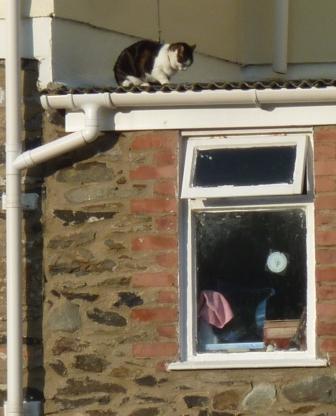
I’ve only ever shared The Insert Game with friends before. The example I’ve created for this week’s blog involves a cat. (Not surprising since I love cats!) So my illustrations today are also of cats – one I spotted on a Pembrokeshire roof, the neighbours’ slinky gray, our own lovely black cat Minky and an exotic Brixton stray cat which we refer to as Big Balls (because that’s what he has).

The Insert Game: Background

I quite literally developed this game in a dream. (more…)

Storytelling Starters ~ Games

Saturday, April 14th, 2012

Games – what for?

Two nights ago, down here in Pembrokeshire, I went to a most powerful play. The Radicalisation of Bradley Manning has been written by young Welsh playwright, Tim Price, now starting to make a considerable name for his work. The play deals with the case of the US soldier currently in confinement and awaiting court martial for bringing a vast mass of military secrets to public knowledge via Wikileaks. Should Bradley Manning be punished or freed? Was he mentally dysfunctional and to be despised for his actions? Or was his whistleblowing – for instance on US army killings of Iraqi civilians – morally defensible and to be applauded in the cause of right thinking and right action?

What made Tim Price’s play so particularly powerful for me when I saw it is that it took place in the main school hall of Tasker Milward School in Haverfordwest. This is a place which Bradley Manning must have known well in his teenage years. After he was brought back from America by his Welsh mother following her split from his father, he was a pupil at Tasker Milward for several years before returning to the US and becoming a soldier. Tasker Milward is significant for me. My mother went to the original Taskers High School. I’ve done several big storytelling projects there. And  watching the play, I was in the company of a friend who actually taught Bradley Manning.

The production of The Radicalisation of Bradley Manning was by National Theatre Wales. The six young actors were brilliant. In every conceivable way – and it was a highly innovative, loud, inventive, multi-media production – they and the play were deeply engaging, obliging you to think on the spot about your views of people and of what is right and wrong.

War Games! They may seem a long way from Storytelling Games – except that they both make you THINK! I can only think that that’s a good thing.

Games: the benefits (more…)